Friday, May 09, 2014

Capacity focus, 85a: The church and sound stewardship of the environment vs. the "it's the Christians' fault" accusation

For many years, the Christian Churches have -- in aggregate -- been the largest single voluntary social activity in the Caribbean region . . . perhaps, the largest single activity, period.

Also, the Churches, collectively, are the guardians and primary transmitters of the Judaeo-Christian ethical tradition, which has decisively shaped our civilisation, overwhelmingly for the good.

That is why it was so disturbing to observe the following in the Tellus report on Environment management in the Pacific region: 
The Church plays a central role in the lives of Pacific islanders. 
More than 80% of Pacific islanders resource owners are devout Christians. This is the source of considerable (but often invisible) conflict between environmental organizations and Pacific islanders. People in governmental, international, and non-governmental environmental organizations in Australia, New Zealand, and the United States are often not Christian, and sometimes are overtly anti-Christian. This schism prevents communication on critical issues of morality that are the heart of all environmental problems. There is a total lack of the word God in almost every governmental or intergovernmental document on the environment or resource use. The word Church does not appear in Agenda 21. Spiritual appears only three times (Chapters 11,15, and 36) but not in reference to a motivation for sustainability or environmental protection. 

Government agencies co-opted environment when the concept emerged from concerned natural scientists and public health and natural resource departments. They went on to formulate legislation within political and economic contexts. 

The Church paid little attention to the whole affair as it was, after all, a governmental matter, linked to water and sanitation. In addition, the environmental movement was full of "naturalists" who damned the Christian ethic as a major cause of environmental abuse . . . 
Environmental concerns often come to us in the guise of the lab coat of science, which is what lends concerns and issues raised by advocates and activists a degree of plausibility and credibility. However, too often, that is coloured by the underlying commitment to naturalism and evolutionary materialism, and associated "progressivist" (or, "liberal" . . . in the contemporary, not the classical, sense) ideologies.

Obviously, one so indoctrinated will tend to be dismissive of or outright hostile to the Christian faith and its message, including its ethical principles. And, from that it is but a step to project blame that it is the Christian message that one should dominate the Earth that feeds the environmental insensitivity of Western Civilisation. 

So, it is no surprise to see (for one instance) Steven Bouma-Prediger, of Hope College, summarise the radical secularist Environmentalist's complaint on the way to composing a response:
Nature, the world, has no value, no interest for Christians.
The Christian thinks only of himself and the salvation of his soul.1
The epigraph above, from prominent mid-nineteenth century writer [--> and philosophical atheist] Ludwig Feuerbach, indicates one common answer to the question of why we are in eco-crisis: Christianity is to blame.

If nature has no value for Christians, who think only about the salvation of their souls, then it is no surprise that the earth is in such sorry shape, given the influence Christianity has had and continues to have around the world. Updated versions of this argument go something like this:

To the extent that man fulfills the command to be fruitful and multiply, his assault on this planet will continue. Religions assume that whatever sacrifices may be necessary to accommodate more of humanity should be made by species other than us. Having created God in man's own image, Western religion has adopted an anthropocentric mythology that separates God from Creation, soul from body, and man from Earth. It is this dualism that prevents us from relating not only to the
natural world, but to ourselves.
These responses -- in an issue of Sierra, the official publication of the Sierra Club -- were given in answer to the question of whether organized religion has benefited or harmed the planet.2
____________

1] Ludwig Feuerbach,The Essence of Christianity (New York: Harper and Row, 1957), 287
2] Sierra (May - June 1993): 112.
The main clue in this is the assertion "[h]aving created God in man's own image . . . " and the dismissive assertion that the Christian Faith is effectively a "mythology."

In short, we are dealing with expressions of evolutionary materialism-driven atheistical thought, wearing the lab coat of science (presumed to be the true prophet on the nature of reality) and then expressing ecological and linked concerns as a part of one particular movement that has risen to prominence in recent decades. Thus, it is utterly unsurprising to see that there is an alienation from the Christian faith and a tendency to project blame and cast it as a scapegoat, as was hinted at by Tellus.

So also, unless the root of the hostility is sufficiently addressed, any attempt to approach "Faith leaders" or adherents, will forever be tainted by the question of co-optation and manipulation driven by implicit contempt.

As a quick, first "clear the air" point of basic facts, we should recognise that the ecological disasters of the Soviet bloc and Communist China -- officially atheistical, evolutionary materialist ideologies -- should serve to show any reasonable person that there is no necessary connexion between atheism or secularism or evolutionary materialism on the one hand and support for environmental concerns on the other. An organisation like the Sierra Club should have been well aware of that even a decade before the Iron Curtain fell and revealed the mess to one and all. So, there is no proper excuse of blameless ignorance there. 

Likewise, given that the Bible views the Earth as "good" and as the Creation of the Good God, who is its Lord, and of whom we are stewards who were originally placed in a garden to tend it, should show that (while indeed many Christians have been and to this day are insensitive to credible environmental issues) there is a basis for a Christian concern for environment and sustainability. 

And given widespread polarisation in our civilisation over evolutionary materialism and secularist progressivism, secularists -- who have had ever so many of their leading spokesmen speak of Christians and the Christian Faith with utter contempt that in some cases verges on unbridled hate -- should understand why many Christians will be very wary of their claims and agendas indeed.

The playing field needs to be levelled a bit, before genuine progress can be made.

As a second step, let us therefore note a second facet to Tellus' remarks:
The environmental mobilization of the world's churches began in 1992 [the year of the Rio Summit that issued Agenda 21] with a summit meeting between scientific and church leaders in Washington DC. Prominent scientists openly asked church leaders for help, explaining that environmental problems were basically spiritual and moral issues, not scientific problems . . .
Given the polarisation we have just outlined, even this statement may not be as innocent as it appears. 

That, sadly, is how tainted the matters now are.

However, it has in it a grain of key truth, for the sustainability principle is in the end an ethical one, it addresses values and ought-ness:
  •  as valuable creatures in ourselves with an inherent dignity that gives us rights, we ought to be able to meet our needs adequately, so
  • in cases where there is conflict over scarce resources and competing demands or desires, we ought to meet our needs fairly, with a particular focus on helping the poor and marginalised to meet their needs, then also
  • we ought to reflect on and leave room for . . . and even speak up for  . . . the needs of others of God's creatures, and -- as well --
  • we ought to be concerned for posterity and the state of the world it will inherit from us in the course of time. Which entails that
  • we ought to have a posterity*, i.e. we should multiply and fill the world, within reason.
_________
(*Plainly, too, being fruitful and so having descendants is not reasonably to be equated to "assault[ing] " our home world. That phrasing used by Sierra Club is troubling, as it strongly points to a hostility and contempt to people that should give us pause.)
This surfaces deep challenges to the evolutionary materialist worldview.

First, let us observe noted spokesman Richard Dawkins:
Nature is not cruel, only pitilessly indifferent. This lesson is one of the hardest for humans to learn. We cannot accept that things might be neither good nor evil, neither cruel nor kind, but simply callous: indifferent to all suffering, lacking all purpose . . . . In a universe of electrons and selfish genes, blind physical forces and genetic replication, some people are going to get hurt, other people are going to get lucky, and you won’t find any rhyme or reason in it, nor any justice. The universe that we observe has precisely the properties we should expect if there is, at bottom, no design, no purpose, no evil and no good, nothing but pitiless indifference . . . . DNA neither cares nor knows. DNA just is. And we dance to its music. [ “God’s Utility Function,” Sci. Am. Aug 1995, pp. 80 - 85. Emphases added.]
Similarly, on "you won't find any rhyme or reason," we can note a point long since emphasised by noted evolutionary thinker J B S Haldane:
"It seems to me immensely unlikely that mind is a mere by-product of matter. For if my mental processes are determined wholly by the motions of atoms in my brain I have no reason to suppose that my beliefs are true. They may be sound chemically, but that does not make them sound logically. And hence I have no reason for supposing my brain to be composed of atoms. In order to escape from this necessity of sawing away the branch on which I am sitting, so to speak, I am compelled to believe that mind is not wholly conditioned by matter.” ["When I am dead," in Possible Worlds: And Other Essays [1927], Chatto and Windus: London, 1932, reprint, p.209. (Highlight and emphases added.)]
In short, there is a serious question as to whether evolutionary materialism can adequately ground the knowing, reasoning mind, and morals. This last reflects the IS-OUGHT gap issue that Hume and others have highlighted, such that only if there is a grounding IS in the basis of a given worldview, can that view support OUGHT as more than in the end, wishes, feelings and desires -- perhaps backed up by might and/or manipulation: might and manipulation make 'right' in effect. 

Where, in a worldview founded on matter and energy interacting through blind chance and mechanical necessity across space and time, there plainly will be no such IS.

Arguably, then, evolutionary materialism is inherently amoral and radically relativist or even subjectivist, so that for instance Ruse and Wilson went on record:
Morality, or more strictly our belief in morality, is merely an adaptation put in place to further our reproductive ends. Hence the basis of ethics does not lie in God’s will  . . . In an important sense, ethics as we understand it is an illusion fobbed off on us by our genes to get us to cooperate. It is without external groundingEthics is illusory inasmuch as it persuades us that it has an objective reference. This is the crux of the biological position. [Michael Ruse & E. O. Wilson, “The Evolution of Ethics,” Religion and the Natural Sciences: The Range of Engagement, , ed. J. E. Hutchingson, Orlando, Fl.:Harcourt and Brace, 1991.]
That will of course immediately raise serious concerns among Christians, but it should also be of deep concern to secularist environmentalists. If we -- rightly -- sense that we OUGHT to care the environment, does that not point to a need for a framework for the world that grounds OUGHT?

And, in case someone thinks that there is no genuine objectivity to ethics, consider that it is self-evidently true that it is wrong to kidnap, torture, rape and murder a child, so much so that if we see such happening we will naturally do what we can to stop the monster.  And one who denies that he or she would have such a duty towards the victimised child simply reveals ethical blindness. rights are real, and a right to life etc means that others have a duty to respect and protect persons with such rights.

So, we have to ask: what adequately grounds OUGHT?

(Something must.)

Where, across time, the only IS that has shown capability to so ground OUGHT is the inherently good creator God, of whom we are stewards responsible for our home planet as well as our souls.

So, it looks like the shoe is now on the other foot.

Yes, people of all sorts of stripes of worldview have been environmentally irresponsible. Yes, it is proper to be concerned over that, and to see how we can make a positive difference. Yes, in so doing, we should seek to better, more fairly meet our needs, so husbanding our common world that our children will also be able to adequately meet their needs.

But to do so, we need a solid basis for OUGHT. 

And a Creation -based ethical theistic view can do that. Where also, if one is concerned tha the Christian Faith is an empty myth, then it may be helpful to watch this following video (as a start):


(Also cf here.)

The time for contempt towards Christians is over.

And, there is no good reason why good Christians cannot at the same time have concern to be good stewards of our common home world, and for reaching out to the poor, the voiceless and the marginalised. END

Capacity focus, 85: Addressing the triple-challenge of soundness in Natural Resources/ Hazards Management -- (1) grounding for claims, (2) ethics in decision and action, (3) long-term strategic thinking . . .

The triple challenge of soundness is a major concern as we seek to better, more sustainably manage natural resources and hazards in the Caribbean:
I: SOLID FACTUAL GROUNDING -- claims that constitute the "['scientific'] facts," "principles," "axioms" and premises on which we think, reason, conclude and act must be well established;

II: RIGHTLY GUIDED ETHICS -- the values and norms that guide our prioritising, conflict resolution, decisions and actions must be credible and coherent in light of the sustainability challenge . . .
Better and more fairly meeting our needs today, while so husbanding resources and managing hazards that our children (and grandchildren) can adequately meet their needs tomorrow;
III: STRATEGIC TIMELINESS -- in order to act effectively in good time, we must accurately understand our times, signs/trends, risks, uncertainties, strengths, weaknesses, opportunities, and threats well ahead of the point where -- for want of being "three moves ahead . . ." of the situation on the ground -- we are forced to react urgently in an ill-informed rush or even a panic, in the face of a disastrous crisis.
Plainly, a tall order.

One, that obviously brims over with capacity issues and surfaces many underlying rifts between factions, classes and interests.

But, one that needs urgent attention all across our region.

For example, let us follow up on the Piper's Pond Montserrat situation -- the last remaining  mangrove wetland on that island, that went under the bulldozer recently:


That was maybe a week ago. 

This morning, after a half-night of rain, we see a different picture, from the seaward end this time (as that is where the earth moving machines are now trying to dig a ditch to drain it):


Clearly, a warning on what is possible with such a dumped up "reclaimed" mangrove wetland in case of a heavy rainfall or a storm surge from a hurricane, and a wake-up call to think again.

How, then, do we best respond?

First, as a region we have to make . . . and keep . . . a heartfelt commitment to be strategically sound, prudent, rightly guided and timely.

Often, that is itself quite hard, in the face of competing interests and the balance of power in a community or institution that tends to enforce "business as usual," but it is a necessary first step to a more sustainable alternative path:


Closely linked, there is a need to rebalance the access to credible information and to power distribution across stakeholder groups. Indeed, the concept of more fairly meeting needs today implies that the marginalised need to be brought to the table and empowered, and that -- once significant sustainability concerns arise -- there needs to be enhanced transparency and accountability over decisions and actions by the powerful inside and outside of government. That already brings out a close linkage between seeking the truth and seeking to be in the right.

Tellus -- a noted environmental consultancy group, speaking of the Pacific region, have some significant observations that ring all too true in the Caribbean also:
Environmental and economic policy decisions [are] made on nine levels;
  • Global
  • Regional
  • National
  • Sectoral
  • Local Government (Provincial or District)
  • Community (Village or Sectoral community such as fishers or farmers).
  • Corporate
  • Family
  • Personal
People who make policy decisions at each level have differences in viewpoint, needs, and information availability. The links between these policy decision factions depend on:
  • Overriding political and moral policies
  • Information flow between the levels
  • Current environmental conditions (there can be considerable differences in how people behave during disasters or acute resource shortages).
Conflicts arise between and within each level. The worse the flow of information between the levels, the greater the conflicts and their attendant costs. Each of these levels had its own agenda and special interests. In the Pacific islands information is poorly shared between the various levels creating conflicts, distrust and clouded decisions.
The policy decision making process is driven from its ends; by the survival needs of individuals in the community and the career needs of professionals in the international aid community acting on a global commitment to foster sustainable development, alleviate poverty, and protect the environment. National governments, and their sectoral and provincial components, oscillate between these two poles, normally facing the flow of money while hoping their constituents and resources would at least look after themselves . . . 
Mining, agriculture, forestry, fisheries, energy, and tourism often have conflicting strategies. The efforts to create economic growth, alleviate poverty or improve the environment in one sector may defeat the strategies to achieve the same thing in one of the other sectors. Some examples are:
  • Agriculture promotes growing crops (often of low value) for export. Their plans include large scale farming with clearing of the land and copious use of fertilizers and pesticides. This results in pollution of rivers with silt, nutrients and poisons that cause long-term damage to coral reef habitats and a subsequent loss of fish catch.Forestry promotes large scale logging operations resulting in sedimentation of rivers, habitat destruction, coastal erosion, coral reef death, and permanent loss of agricultural areas through soil depravation, loss of the water-recycling function of the trees, and decreased protection from storms.
  • On coastal areas, multiple demands on resources can lead to open conflict. Fishers, who depend on the coastal area for survival, have a low status and cannot influence coastal zone planning processes aimed at high profile sectors like tourism, housing, and road construction.
  • Development activities from any one sector compete with development activities from all the other sectors. Individual people in a community often engage in farming, fishing, transportation, small scale forestry and tourism activities. Not to mention Church and social obligations. In the Pacific Islands, there are so many development schemes in progress that nobody has time to do any of them effectively. Workshops and conferences can be so numerous, employees in the understaffed government offices find it difficult to get day to day work done.
 In short, we are looking at painfully negotiated compromises, which will too often reflect more of power interests and agendas, than of soundness. And, to hit on a compromise where so many conflicts and interests are at stake, will often take a long time. Which may adversely affect timeliness.

So, we are right back at the force of the need for commitment to act in light of what is sound and manifestly right, in good time.

That then poses capacity-development challenges.

The challenge of natural hazard management allows us to focus this aspect (and a similar framework can be built up for natural resource management):


 We must be able to soundly analyse the hazard in terms of the bio-physical, socio-cultural and economic environmental domains and associated risks, vulnerabilities, range of possible impacts, and coping mechanisms, in order to make soundly informed decisions.  Absent such, we will be running potentially dangerous and reckless hazards. 

Then, we must be willing and able to repeatedly address the risk management cycle across time, indeed, to manage it in light of a portfolio of assessed hazards:


Immediately, it is obvious that as a region, we face major gaps and vulnerabilities.

Given the consequences, we therefore must make a second major commitment, to build up our capacity and a critical mass of consensus in the community to address our natural resources and hazards adequately. Understanding along the way, that we are limited and will make errors, so we need to err on the side of prudence.

With the tyrannies of the distractive urgent circumstances of the day as a further factor to be borne in mind.

So, we are back to the usual question: if not now, then when? If not here then where? If not us, then who? END

Thursday, May 08, 2014

Capacity focus, 84: Natural resources and hazards management as a key plank of sustainable development in the Caribbean

Here in Montserrat (next door to Antigua), much of the history of the past quarter century has been shaped by two disasters, hurricane Hugo in September 1989, and the volcano eruption from July 1995 to the present. 

Between these two events -- especially the eruption that has rendered 2/3 of the island effectively uninhabitable -- we lost a generation of development. 

Development that turned out to be unsustainable, in part because our exposure to natural hazards was not adequately managed in light of seeking and heeding prudent, sober, well-informed  assessment of the implied risks, dangers and uncertainties thence credible alternatives.

At the same time, hopes for recovery and onward development pivot on Montserrat's situation as a well-watered tropical island and on the now demonstrated existence of Geo-thermal energy resources.

Similarly -- and shifting to a more broadly regional focus -- our region's tourism industry pivots on the transformation from disease ridden tropical  death-traps, to tropical island paradises because of careful public health management that has curbed the exposure to ever so many notorious tropical diseases, such as Malaria, Dengue and the like.

All of this tells us just how tightly integrated our bio-physical environment, our societies and our economies are, and so also why natural resources and hazards management are so closely coupled.

Indeed, a natural hazard can be seen as a negative natural resource.

(Or,at least, one outside of its "Goldilocks" -- just right -- zone.)

That is, instead of being an object or phenomenon in or based in our bio-physical environment that enables better meeting our needs, it is a potential danger to us and/or our thriving. For instance, we need and want wind, sun and rain, but those are also the ingredients of a hurricane. Where again, hurricanes and their precursors, tropical waves, bring us a fair proportion of our annual rain. 

That is why we can compare a natural resource identification, development and use cycle:


(Credit: Tellus Consultants)

. . . with a similar cycle for natural hazards/disasters risk reduction and management:


Indeed, if we bring the two together, we can see that these both pivot on the intersection and interaction of the environment domains -- bio-physical, socio-cultural and economic -- and are closely linked to the challenge of sustainable development. 

For the first, to enhance meeting our needs we must first responsibly access resources, and for the second, we must try to mitigate  our exposure to vulnerabilities -- or at least adapt our development planning and path to vulnerabilities that cannot be averted or significantly mitigated.. 

Failing on either front, development will be unsustainable or even absent.

So, we need to balance a focus on our major natural resources:
  • Sun, sea, land, fresh water,
  •  tropical island coastal, watershed and upland ecosystems
  • marine ecosystems and species
  • minerals such as bauxite, titanium, rare earth metals, oil, natural gas, gypsum, and even gold
  • world class beaches, leading up to even more breathtakingly beautiful landscapes with lush tropical vegetation, mountains and abundant biodiversity
  • high endemism in our biodiversity "from ridge to reef"
  • location near the North American and European markets
  • sitting astride or close to key global trade choke-points including the Panama Canal, the Straights of Florida, the straights between Cuba and the Yucatan, etc
  • Major natural harbours (Especially in Jamaica and Trinidad)
  • the two to three pounds of grey matter between our ears
  • the five-pronged appendages at the ends of our arms
. . . with a due recognition of our main natural vulnerabilities such as:
  • Hurricanes
  • droughts and floods (with linked deforestation and siltation)
  • climate/weather patterns, trends and linked extreme events
  • landslide and erosion hazards
  • tropical disease sources, environmental reservoirs and vectors
  • earthquakes
  • volcanoes (especially, explosive island arc volcanoes)
  • tsunamis ("tidal waves") -- connected to volcanoes and earthquakes as well as undersea land-slides
. . . if our development planning is to be truly sustainable.

This moves the sustainability principle to the focus of our development challenge:
SD: Better and more fairly meeting our needs today, while so husbanding resources and managing hazards that our children (and grandchildren) can adequately meet their needs tomorrow.
From this, in light of the way that our bio-physical, socio-cutural and economic-policy environment domains are inextricably entangled and interacting, we can highlight a cluster of key sectors to focus on . . . with natural resources and natural hazards management being at one of the threeinerfaces between domains:


Consequently, integrated development planning needs to address this matrix of thirty or so focal sectors, including natural resources and hazards as one of the three major interface nodes.  The culture of Governance node implies as well that planning needs to ever more become accountable, transparent and participative, with technical capacity being built up and a well-informed and motivated public.

As a test, let us ask ourselves why we have recently seen this happen to Montserrat's last remaining -- now GONE -- mangrove wetland, when there were reasonable alternatives in developing the new town centre:


Sobering.

And, how many times have stanzas of this same  sad song been sung all over our region?

Likewise, let us ask ourselves, all across this region, how well we meet the test in this panorama of what is required to effectively manage the natural hazards, disasters and emergency cycle:


So, first, in the end, for everything, we use to meet our needs, we require something we grow or mine or hunt, as a natural resource base. And, if we live in an environment we will have hazards, that we need to develop capacity to manage soundly. 

And so, again, if not now, when; if not here, where; if not us, who? END

Wednesday, May 07, 2014

Sci-tech watch, 19: A look at Rankine-based cycle steam turbines (such as have been used in power plants and ships) and extensions -- for geothermal energy

The classic steam turbine power plant is an example of a system that uses a single working fluid that operates between two phases, e.g. water/ steam, in accord with the Rankine power cycle:


 The addition of superheat allows for greater efficiency, as it runs between a higher top temperature and the lower one, which inherently allows for higher efficiency. This is because the harvestable energy of a Carnot Cycle . . . the physically ideal (but impractical) heat engine . . . is at the physical limit set by the laws of physics:


Efficiency = (useful energy o/p) / (required energy i/p)

Input heat drives the cycle giving work and
exhaust heat at the cold temp
Carnot Cycle, running between Thot and Tcold:


Efficiency =  1 - (Tcold / Thot)
T is in Kelvins, relative to absolute zero, and so if Tc = 303 K (86 degrees F or 30 degrees C) and Th = 523 K ( 250 degrees C or 482 degrees F) then ideal maximum efficiency is 42%.

 In realistic cases, we may be at perhaps 1/2 that ideal, though some systems do better. 

250 degrees C is of course a reported temperature for fluids recently discovered in Montserrat through two exploratory GT wells that have been drilled down about a mile and a half underground.

For reference, Wiki notes:
In practice, a steam engine exhausting the steam to atmosphere will typically have an efficiency (including the boiler) in the range of 1-10%, but with the addition of a condenser and multiple expansion, and high steam pressure/temperature, it may be greatly improved, historically into the regime of 10-20%, and very rarely slightly higher.

A modern large electrical power station (producing several hundred megawatts of electrical output) with steam reheat, economizer etc. will achieve efficiency in the mid 40% range, with the most efficient units approaching 50% thermal efficiency. (Cf. onward reference to Power Engineering magazine, here.)


A classic video is helpful to understand how the turbine stage of the plant works:


 An important factor is that by condensing the steam, the back end pressure is reduced, allowing for a greater efficiency of harvesting energy from the flow of the working fluid. (This is an advantage over the windmill, which is unable to readily condense the downstream flow into a vacuum plus a liquid. That leads to the Betz limit where a wind turbine can extract only about up to 59.3% of the power in flowing air. A Steam turbine may approach 90% extraction from the steam flow, though of course a so-called back flow turbine is much simpler and cheaper.)

For geothermal energy, the source of the hot working fluid is a well bored deep into the earth which draws off hot fluids -- percolating rain-water or sea-water or both -- heated by hot rocks, which makes superheat a bit of a moot point, but eliminates the need for a fuel source for heating:


Latent heat and vapourisation for water etc (HT: WIki)
 Here, in a slide from Uni of Auckland, we see how perhaps about 3/4 of the fluid from the well is lost in the separator, and the 25% of harvestable steam is then used to run the turbine which turns the shaft that drives the generator. (NB: A significant part of the fluid may already be steam coming up from below, in a mixed phase fluid.)

Where, also, it must be recalled [cf. graph to the left], to flash one kg of water into steam in the relevant temperature range requires some 1.5 - 2.2 MJ of latent heat . . . depending on how close we are to the critical point of water (beyond which a liquid is not physically possible -- we have a permanent gas). That imposes a limit on the available steam and implies degradation of the heat content of the remaining hot liquid. 

So, the liquid remaining after flashing is significantly degraded, and there is a practical limit on how much of it can be flashed. 

The steam-flash approach generally requires temperatures in excess of  150 degrees Celsius in order to work adequately. Though, under reduced pressure, further flashing could be done. Such reduced pressure will however affect the available power in the flow of steam.

Below 150 degrees C, it begins to make sense to switch working fluids, to substances with lower boiling points, such as iso-butane or iso-pentane, which are used in an organic working fluid Rankine cycle, generally without super-heat. (Such cycles also make sense for G-T brines that are chemically aggressive, e.g. highly acid.)

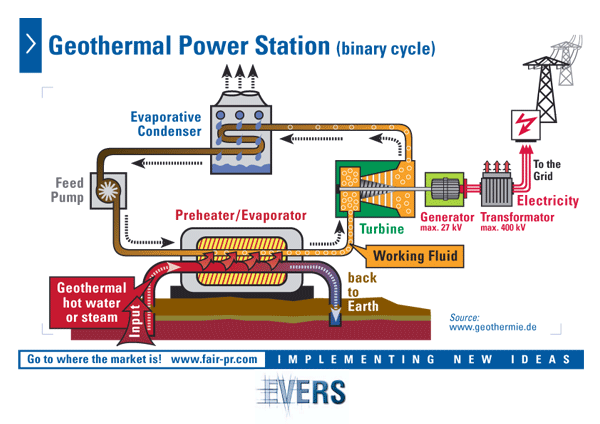
That brings to bear binary G-T plants, e.g.:


As can be seen, the working fluid is flashed into gaseous state in a heat exchanger, the preheater/evaporator, which uses the hot G-T fluid (up to perhaps 150 degrees C) as heating source.

This causes an obvious additional loss of efficiency, which typically rides on the already low efficiency produced by having a low temperature source. [A Carnot cycle running between 150 degrees C ( 423 K) and the 30 degrees above, would max out at about 28%, with of course practical systems being much below this. That is, there is a difference between ideal potential and practical achievable output given losses and parasitic loads such as pumps, etc. Typical practical efficiencies for a binary G-T cycle may run 10 - 13%.]

That makes the Binary approach of limited use with small sources with high enough temperature, where whatever efficiency we can harvest will be at a premium. However, if we wish to wring out energy from the 3/4 or so of liquid that would perhaps otherwise be wasted, a binary module may be of help.  Auckland Uni provides a case, due to ORMAT:


Such modularity would also be of help in load following, as well as perhaps in switching from one unit to the next, in support of regular maintenance downtime.

Ormat says of such an approach:
Ormat Geothermal Combined Cycle Units (GCCU) are designed to generate power from high-pressure geothermal steam resources. When there are non-condensable gases present in the geothermal steam, our GCCU technology provides higher efficiency, lower maintenance costs and higher electrical output in comparison to conventional condensing steam power plants. Ormat offers GCCU modules in a wide range of sizes in order to accurately match the power plant to the geothermal energy resource. The result is significant savings in well drilling and resource development. The GCCU can be air-cooled so that all steam condensate can be 100% re-injected.  Total fluid re-injection sustains reservoir life and provides pressure support. Due to the low profile of the air-cooled condensers and the lack of any plume from the water cooling towers, the visual impact is minimized and the risk of acid rain is minimized as well.  
In turn, the use of turbines in all the possibilities above brings up the issue that turbines strongly prefer to work near rated load, pointing to the better load following capability of piston based engines -- never mind the disadvantages of such engines in terms of inherent tendency to more vibration/noise and maintenance requirements because of numbers of moving parts.

Of these the standard developed across C19 was the triple expansion steam engine, as is shown, courtesy Wiki.
Triple expansion piston engine

At each stage, a double-acting valve pushes the engine two ways, then feeds the next stage with its exhaust. As the steam will need to expand as its temperature is lowered, each stage is progressively bigger physically. (To give an idea of scale, the 1.9 MW triple expansion plants used in the old Liberty Ships of the Second World war to drive their screws were about 20 ft high and similarly long, and perhaps 7 ft wide.)

As Wikipedia comments: 

These engines use a series of cylinders of progressively increasing diameter. These cylinders are designed to divide the work into equal shares for each expansion stage. As with the double expansion engine, if space is at a premium, then two smaller cylinders may be used for the low pressure stage. Multiple expansion engines typically had the cylinders arranged inline, but various other formations were used. In the late 19th century, the Yarrow-Schlick-Tweedy balancing 'system' was used on some marine triple expansion engines. Y-S-T engines divided the low pressure expansion stages between two cylinders, one at each end of the engine. This allowed the crankshaft to be better balanced, resulting in a smoother, faster-responding engine which ran with less vibration. This made the 4-cylinder triple-expansion engine popular with large passenger liners (such as the Olympic class), but this was ultimately replaced by the virtually vibration-free turbine . . . 
Such devices, obviously are still a possibility, but they would be rather specialist items now, and the implications of vibration for wear, tear and metal fatigue should be noted.

Of course, for Montserrat, it is being suggested that the GT component should be joined to a diesel plant, and to wind etc as relatively minor components.

Diversity enhances reliability.

However, a major motivation for the move to G-T energy and other sources is to get out of dependence on oil, for economic and environmental reasons. 

Where, also, it bears noting that it is not unusual to see G-T plants turning in availabilities of 95 - 98%, placing them among the most reliable technologies in the world. That suggests that if the plant can be based on several modules of unequal size . . . say (for argument) 1. 8 MW flash, 1.2 MW Binary 1 and 0.6 MW Binary 2 [or, perhaps 3 x 0.6 Binary modules] . . . then we can see that the three units can be used in various combinations up to 3.6 MW that would allow significant load following and would regularly release each unit in turn for maintenance support, leading to a much enhanced system reliability.

Let us see how things come out in the end. END

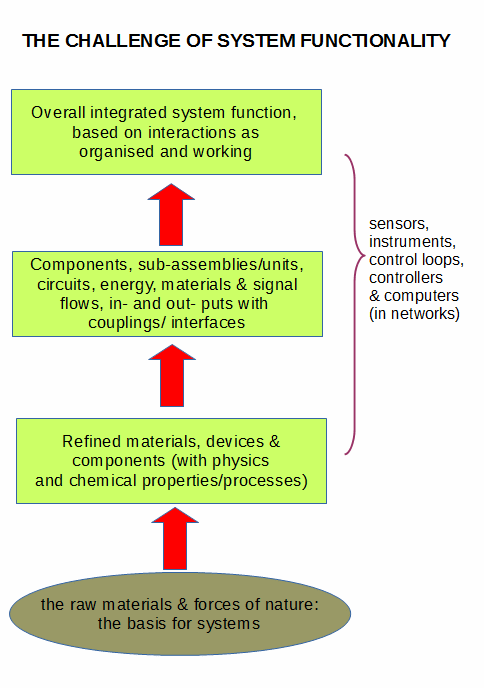
Sci-tech watch, 18: "It's rocket science" -- a lesson on the importance of getting the details, interfaces and overall system right to get effective integrated function (thus also, on paying the price of investing in exploration and in risk in order to build a basis for future success)

One of the common failings of thought in the Caribbean is the tendency to overlook the critical importance of getting details right, and to therefore miss why it is important to work through the analysis and the debugging- troubleshooting- development process taking pains and time to get things right.

That means it can be hard to get a new approach just right first time up, but that does not mean that one can then shoot holes in it and dismiss then go back to business as usual.

We have to learn to swallow the cost of partial successes, and build on them to gain the experience base for virtuoso performance that makes it LOOK easy.

Where also, this is connected directly to the Hayek investment triangle that culminates in a perfected product on the market:


So, let's pause and watch a video on a foray into rocketry by an electrical engineer, a mechanical engineer and a builder, courtesy "How hard can it be":


How hard can it be? 

Quite hard.

(For instance, a rocket is in effect a broom supported and lifted from below,  on the tip of a "finger," with the lifting force being a controlled explosion creating a jet. The system is inherently unstable, highly non-linear . . . thus not well behaved . . .  and likely to be self-destructive. Notice, here, the bunkers in the amateur rocketry launch field. And notice how the potential for failure rises with scale.)

In general we face:


And, if it is not hard, then it's easy to copy and so you are back to the game of competing on costs and price, which -- long term -- spells economic death.

So, we need to shift to an exploratory and entrepreneurial seed-sowing mindset [a sower went out to sow . . . ], that willingly bears the risk and cost of discovery and development, to build a foundation for future success. Recognising, that -- on track record -- successes will pay the cost of failures and that without risk, there is no long term hope for advance. END

PS: On building rockets, watch:


Sunday, May 04, 2014

Matt 24 watch, 240: Are the kidnapped Nigerian school girls being forcibly married to their captors? (With some revealing forced admissions against interest in typical leading media on IslamISM)

Over the past few days, reports suggest that indeed, the kidnapped school girls in Northern Nigeria are being forcibly married to their captors.

From Guardian, April 29:
For two weeks, retired teacher Samson Dawah prayed for news of his niece Saratu, who was among more than 230 schoolgirls snatched by Boko Haram militants in the north-eastern Nigerian village of Chibok. Then on Monday the agonising silence was broken.

When Dawah called together his extended family members to give an update, he asked that the most elderly not attend, fearing they would not be able to cope with what he had to say. "We have heard from members of the forest community where they took the girls. They said there had been mass marriages and the girls are being shared out as wives among the Boko Haram militants," Dawah told his relatives . . . . 

Reports of the mass marriage came from a group that meets at dawn each day not far from the charred remains of the school. [--> School burners] The ragtag gathering of fathers, uncles, cousins and nephews pool money for fuel before venturing unarmed into the thick forest, or into border towns that the militants have terrorised for months.
On Sunday, the searchers were told that the students had been divided into at least three groups, according to farmers and villagers who had seen truckloads of girls moving around the area. One farmer, who spoke on condition of anonymity, said the insurgents had paid leaders dowries [--> so the leaders were viewed as owners of the girls . . . ] and fired celebratory gunshots for several minutes after conducting mass wedding ceremonies on Saturday and Sunday.
"It's unbearable. Our wives have grown bitter and cry all day. The abduction of our children and the news of them being married off is like hearing of the return of the slave trade," [--> Which, inside Africa, was based on kidnapping and was in major part carried out by Muslim Arab, Berber and "Arabised" tribes, with an emphasis on getting girls and women; the excess, especially males, were sold to the Europeans with their Atlantic crossing merchant ships . . . ] said Yakubu Ubalala, whose 17- and 18-year-old daughters Kulu and Maimuna are among the disappeared.

Here is a backgrounder from CNN that admits more than is usual from such a source:
Why does Boko Haram kidnap girls?
The Islamist militants' name [--> notice, use of IslamIST] translates to "Western education is a sin" in the local language. [--> using one term that is obviously "book" -- boko, and one that comes from Arabic by way of Islam, haram . . . forbidden; adding up, books [= "western" education] are forbidden by ruling them as "sin" ]

The group especially opposes the education of women. Under its version of Sharia law [--> It is taking a reading of Sharia, the standard legal corpus of Islam, that is very similar to that of the Taliban and Al Qaeda etc so this is not an odd idiosyncrasy, there is something "there" that is driving this . . . ], women should be at home raising children and looking after their husbands, not at school learning to read and write. [--> It must be said in balance that Mohammed's wives were clearly literate, so someone is playing self-serving games with the principle of M. as exemplar in Islam]

It has repeatedly targeted places of learning in deadly attacks that have highlighted its fundamental philosophy against education.

The spate of kidnappings began in May 2013 when Boko Haram leader Abubakar Shekau announced in a video that this was part of its latest bloody campaign. The kidnappings, he said, were retaliation for Nigerian security forces nabbing the wives and children of group members. [--> Uninvolved civilians are attacked and hostages are taken under some excuse or other, a typical tactic of Islamist terrorists]

Those kidnapped, he said, would begin a new life as a "servant."  [--> read: slave]

Has it kidnapped girls and women before?

Yes.

In November, the militant group abducted dozens of Christian women, most of whom were later rescued by the military deep in a forest in Maiduguri. At the time of their rescue, some were pregnant or had children, and others had been forcibly converted to Islam and married off to their kidnappers.
Rights groups have said Boko Haram has kidnapped girls as young as 12. [--> Mohammed's favourite wife, Aisha, was married to him at 6 or 7 and the marriage was "consummated" when she was 9 or 10]
And the abductions are only getting worse.

In the first two months of this year alone, it kidnapped at least 25 girls and women, according to Human Rights Watch.
Let's put it this way:
1 --> You (down to 12 years of age . . . a first or second former in effect) are taken from school by terrorists at gun point

2 --> They drive you off into the forest

3 --> They control everything, you are a captive . . . in fact, a slave

4 --> You are asked to marry one of your captors (which is a bit of a promotion from being an outright slave taken in "war" who per Sharia may be used sexually at pleasure as a concubine), and may be put under pressure to convert to Islam

5 --> Remember, guns, machetes and knives etc are at all times hovering in the background
In short, all of this is kidnapping, hostage taking, disguised enslavement and attempted robbing of the soul.

Now, let us pose a question or two, of context:
A: In a world where when an imaginary destruction or defacing of a Quran excites riots across the Islamic world, where are the denunciations of Boko Haram as heresy and as murderous terrorists, demanding that they release all these girls unharmed?

B: What, then should we conclude? (As in, does not silence sometimes speak even louder than shouting?)
It it time for us to think for ourselves on these matters: do we want to live in a world or even a region dominated by this sort of Boko Haram -- books forbidden -- mentality?* END

*PS: I am fully aware that there are ever so many anti-God skeptics and cynics today who will gleefully extend this from the case of extreme Islamism to "Religion," with particular reference to Bible-believing Christian faith. That resort to cheap accusation by invidious association speaks volumes on their irresponsibility. First, while there are too many Muslims who do this or support those who do, this is not how most ordinary people who are Muslims think or behave. Second, such cynics need to take time to examine the foundations of the Christian Faith and of Gospel Ethics, as can be seen from an example discussed here at KF blog  recently.

Sci-tech watch, 17: Are there now 250,000 new computer viruses per day? (A James Lyne TED Talk on handling today's cybercrime, viruses etc . . . with a warning on why the nearly 25% of PCs in the world still using it should move on from Windows XP. )

In following up on the Heartbleed Internet Explorer security scare (cf. here, updated with the patch), I ran across an article and TED talk by James Lyne,"Global Head of Security Research for Sophos, one of the worlds largest security companies." The video is sobering:


And yes, it shows how hacking is now a marketplace with applications and all the trimmings, including adverts and even tech support. Yes, tech support for malicious code and cyber attacks. Oh, yes -- fake anti virus scare you into downloading the virus software, too. (You will love the part on giving you a list of fake infections to be fixed.)

Lyne also cautions in the article:
Microsoft Windows XP is no longer supported which means you don’t receive patches for security problems (or any other problems) that may impact your system. Unfortunately it is estimated that nearly 1/4 of PCs worldwide are still using the platform (though hopefully dropping off quickly) . . . . 

Let me make it plain and simple for anyone still on XP. Microsoft of course has commercial and product motives for wanting you to move on to Windows 7 or 8, but from a security perspective they just aren’t wrong. Windows 8 is an operating system with in excess of 10 years of architectural and security enhancements over XP. The number of vulnerabilities in applications may not be reducing (and the quality of code sometimes can be staggering) but I speak from first hand experience when I say that turning such a fault in to a useful, working exploit to attack a system is significantly harder on Windows 8.1 than on Windows XP . If you haven’t planned your migration already you should do so now and for enterprises and SMEs make sure you think beyond the desktops and laptops – do you have printers or ‘embedded devices’ which vendors need to update or replace too?
So, use the XP operating system  only under warning. And' don't count on its security. (Though, with those numbers it is likely that third parties will probably issue unofficial patches etc. But that is different from Microsoft doing so.)

I suggest as well, keep an eye out on the trend to diversify operating systems, e.g. I have recently seen all-in-one desktop "super-tablets" on Amazon that use the Android operating system. Which, being LINUX-based, effectively a version of UNIX, is inherently quite secure.

But in truth, as the wife of a hacker mentioned in the TED talk demonstrated, no computer system is more secure than its user. (And no, it's not just emails about being widows of Bank Presidents that we need to be concerned about, e.g. think twice about what you put up online in social media. For instance pictures you upload may give the GPS co-ordinates of where you are to within about two cricket pitches [~ 50 yards] distance . . .  -- as the TED talk brings out. Yes, take time to watch.) 

Sobering and eye-opening.  END