Saturday, December 01, 2018

Pakistan PM (and cricketer) Imran Khan ill-advisedly claims "there is no mention of Jesus in history"

As MEMRI translates and reports, Pakistan's new(ish) Prime Minister has recently joined the "Jesus is [largely] a myth" club:
 Imran Khan: There were prophets of Allah other [than Muhammad], but there is no mention of them in human history. There is negligible mention of them. Moses is mentioned, but there is no mention of Jesus in history. But the entire life of Muhammad, who was Allah's last prophet, is part of history.
 Immediately, this reflects an unwarranted but all too common anti-Christian bias against the eyewitness-lifetime New Testament documents; which are collectively historically and archaeologically well supported, with Luke-Acts as backbone. Secondly, on fair comment,  it fails to recognise the difference in immediate public profile between a peaceful teacher and martyr and a ruler of an expanding state that imposed its will by the sword, which would obviously draw widespread attention. It is also tellingly ignorant of the cluster of early cross-references that provide corroboration to the outline of Jesus' life. 

 In case you need a reminder from "last time," on the atheistical front, notice this equally ill-advised assertion:


 These two incidents of course reflect the two tidal waves pattern of cultural challenges to the Caribbean that we have so often highlighted:
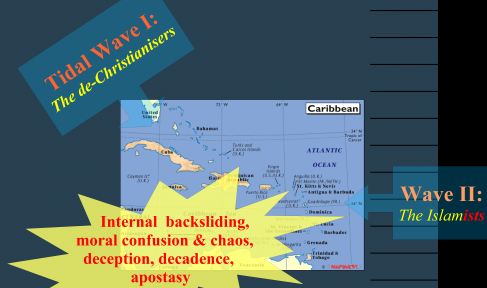


Of course, this points to the opportunity for us to rise up as the third tidal wave -- one that brings the Good News as the true "light rising in the West" (as UWI's motto declares):


Now, in first answer to Mr Khan and the atheists and fellow travellers of the FFRF, let us observe what Australian scholar Paul Barnett long since aptly  and succinctly noted in Is the New Testament History?:
On the basis of . . . non-Christian sources [i.e. Tacitus (Annals, on the fire in Rome, AD 64; written ~ AD 115), Rabbi Eliezer (~ 90's AD; cited J. Klausner, Jesus of Nazareth (London: Collier-Macmillan, 1929), p. 34), Pliny (Letters to Trajan from Bithynia, ~ AD 112), Josephus (Antiquities, ~ 90's)] it is possible to draw the following conclusions:
    1. Jesus Christ was executed (by crucifixion?) in Judaea during the period where Tiberius was Emperor (AD 14 - 37) and Pontius Pilate was Governor (AD 26 - 36). [Tacitus]
    2. The movement spread from Judaea to Rome. [Tacitus]
    3. Jesus claimed to be God and that he would depart and return. [Eliezer]
    4. His followers worshipped him as (a) god. [Pliny]
    5. He was called "the Christ." [Josephus]
    6. His followers were called "Christians." [Tacitus, Pliny]
    7. They were numerous in Bithynia and Rome [Tacitus, Pliny]
    8. It was a world-wide movement. [Eliezer]
    9. His brother was James. [Josephus]
[Is the New Testament History? (London, Hodder, 1987), pp. 30 - 31. Cf. McDowell & Wilson, He Walked Among Us (Nashville, TN: Thomas Nelson, 1993) for more details; free for download here.]
 Such already suffices to refute Mr Khan's claims on want of relevant historical reference from Non-Christian sources.

It is important to focus the NT testimony. So, turning to Peter's theological will, 2 Peter, we may see also a telling rebuke to all such "myth" claims; in a record c. 65 AD that was literally sealed with this martyr's blood:
2 Pet 1:16 . . .  we did not follow cleverly devised myths when we made known to you the power and coming of our Lord Jesus Christ, but we were eyewitnesses of his majesty. 17For when he received honor and glory from God the Father, and the voice was borne to him by the Majestic Glory, "This is my beloved Son, with whom I am well pleased," 18we ourselves heard this very voice borne from heaven, for we were with him on the holy mountain.
19And we have something more sure, the prophetic word, to which you will do well to pay attention as to a lamp shining in a dark place, until the day dawns and the morning star rises in your hearts . . . [ESV]
Similarly, we note the official summary of the church's C1 first generation witness that Paul recorded 55 AD, recording the testimony of the 12 and the 500 which dates to 35 - 38 AD in Jerusalem (a key site, within a decade of the events):


1 Cor 15:1Now I would remind you, brothers, of the gospel I preached to you, which you received in which you stand, 2and by which you are being saved, if you hold fast to the word I preached to you . . .


3For I delivered to you as of first importance what I also received: that Christ died for our sins in accordance with the Scriptures [--> cf. esp. the c. 700 BC Isa 52:23 - 53:12], 4that he was buried, that he was raised on the third day in accordance with the Scriptures, 5and that he appeared to Cephas, then to the twelve.

6Then he appeared to more than five hundred brothers at one time, most of whom are still alive, though some have fallen asleep. 7Then he appeared to James, then to all the apostles.8Last of all, as to one untimely born, he appeared also to me. 9For I am the least of the apostles, unworthy to be called an apostle, because I persecuted the church of God . . . 

11Whether then it was I or they, so we preach and so you believed. [ESV]

We may also observe Luke's introductory remarks for his two-volume work (which by its 62 AD cut-off in Ac 28 shows how its base form dates to 57 - 62 AD, using Mark as a key underlying source [which therefore dates to the 40's - 50's AD and which records Peter's detailed testimony]:
Lk 1: 1 Inasmuch as many have undertaken to compile a narrative of the things that have been accomplished among us, 2 just as those who from the beginning were eyewitnesses and ministers of the word have delivered them to us, 3 it seemed good to me also, having followed all things closely for some time past, to write an orderly account for you, most excellent Theophilus, 4 that you may have certainty concerning the things you have been taught. 
 5 In the days of Herod, king of Judea, there was a priest named Zechariah,1  of the division of Abijah. And he had a wife from the daughters of Aaron, and her name was Elizabeth . . . . 
Ac 1: 1 In the first book, O Theophilus, I have dealt with all that Jesus began to do and teach, 2 until the day when he was taken up, after he had given commands through the Holy Spirit to the apostles whom he had chosen. 3 He presented himself alive to them after his suffering by many proofs, appearing to them during forty days and speaking about the kingdom of God. 
 4 And while staying  with them he ordered them not to depart from Jerusalem, but to wait for the promise of the Father, which, he said, “you heard from me; 5 for John baptized with water, but you will be baptized with2  the Holy Spirit not many days from now.”
 6 So when they had come together, they asked him, “Lord, will you at this time restore the kingdom to Israel?”
7 He said to them, “It is not for you to know times or seasons that the Father has fixed by his own authority. 8 But you will receive power when the Holy Spirit has come upon you, and you will be my witnesses in Jerusalem and in all Judea and Samaria, and to the end of the earth.” [ESV]
Turning to chain of custody (the other half of the famous Ancient Documents Rule), we can summarise:


Pulling back our focus, we may ponder the impact of the minimal facts method, as Habermas and others note how -- per an ever growing survey of the literature across the range of views (apparently now approaching or in excess of three thousand sources) -- the majority to an overwhelming majority of scholarship on the passion and resurrection of Jesus accept that we can identify a core of "minimal facts," up to twelve in number. In summary:


The minimal facts method only uses sources which are multiply attested, and agreed to by a majority of scholars (ranging from atheist to conservative). This requires that they have one or more of the following criteria which are relevant to textual criticism:

    1. Multiple sources - If two or more sources attest to the same fact, it is more likely authentic
    2. Enemy attestation - If the writers enemies corroborate a given fact, it is more likely authentic
    3. Principle of embarrassment - If the text embarrasses the writer, it is more likely authentic
    4. Eyewitness testimony - First hand accounts are to be prefered
      Early testimony - an early account is more likely accurate than a later one

Having first established the well attested facts, the approach then argues that the best explanation of these agreed to facts is the resurrection of Jesus Christ . . . . [Source: "Minimal facts" From Apologetics Wiki. Full article: here. (Courtesy, Wayback Machine.)]

 In substance:
1. Jesus died by crucifixion [--> which implies his historicity!].

2. He was buried.

3. His death caused the disciples to despair and lose hope.

4. The tomb was empty (the most contested).

5. The disciples had experiences which they believed were literal appearances of the risen Jesus (the most important proof).

6. The disciples were transformed from doubters to bold proclaimers.

7. The resurrection was the central message.

8. They preached the message of Jesus’ resurrection in Jerusalem.

9. The Church was born and grew.

10. Orthodox Jews who believed in Christ made Sunday their primary day of worship.

11. James was converted to the faith when he saw the resurrected Jesus (James was a family skeptic).

12. Paul was converted to the faith (Paul was an outsider skeptic).

[Cf. Habermas' paper here and a broader more popular discussion here. NT Wright's papers here and here give a rich and deep background analysis. Here is a video of a pastoral presentation of a subset of the facts. Habermas presents the case as videos here and here, in two parts. Here is a video of a debate he had with Antony Flew.]
 The power of the method then lies in challenging alternative explanations to account for the relevant credible facts:

We may briefly compare:


"Theory"
Match to four major credible facts regarding Jesus of Nazareth & his Passion
Overall score/20
Died by crucifixion
(under Pontius Pilate) at Jerusalem c 30 AD
Was buried, tomb was found empty
Appeared to multiple disciples,
many of whom proclaimed
& suffered for their
faith
Appeared to key objectors who then became church leaders: James & Paul
Bodily Resurrection
5
5
5
5
20
Visions/ hallucinations
5
2
2
1
10
Swoon/recovery
1
3
2
2
8
Wrong tomb
5
1
1
1
8
Stolen body/fraud
5
2
1
1
9
Quran 4:155 -6: "They did not slay him, neither crucified him." 1 1 1 1 4
 "Jesus never existed" 1 1 1 1 4
 "Christianity as we know it was cooked up by Constantine and  others at Nicea, who censored/ distorted the original record" 1 1 1 1 4
"What we have today is 'Paulianity,' not the original teachings of Jesus and his disciples" 2 1 1 2 6
Christianity -- including the resurrection --  is a gradually emerging legend based on a real figure
5
1
1
1
8
Complete legend/pagan copycat (Greek, Persian, Egyptian, etc)
1
1
1
1
4

(I have given my scores above, based on reasoning that should be fairly obvious. As an exercise you may want to come up with your own scores on a 5 - 1 scale: 5 = v. good/ 4 = good/ 3 = fair/ 2 = poor/ 1 = v. poor, with explanations. Try out blends of the common skeptical theories to see how they would fare.)

 Laying a priori anti-supernaturalism aside as a patent case of worldview level question-begging closed mindedness, the above table shows that there are two serious candidates today, the resurrection as historically understood, or some version of a collective vision/hallucination that led to a sincere (but plainly mistaken) movement.

The latter of course runs into  the problem that such collective visions are not psychologically plausible as the cultural expectations of a resurrection would have been of a general one in the context of the obvious military triumph of Israel. Nor, does it explain the apparently missing body. Moreover, we know separately, that the culturally accepted alternative would have been individual prophetic visions of the exalted that on being shared would comfort the grieving that the departed rested with God. So, an ahead of time individual breakthrough resurrection -- even, one that may be accompanied by some straws in the wind of what is to come in fulness at the end -- is not part of the mental furniture of expectations in C1 Judaism.  Where, hallucinations and culturally induced visions are going to be rooted in such pre-existing mental "furniture."

Where, also -- tellingly -- the women who bought spices and went to the tomb that morning plainly expected to find it occupied by a dead prophet, one unjustly judicially murdered as so many others had been.  (And if you doubt the account that reports how these women became the first to discover the tomb and to see the risen Messiah, consider how dismissive C1 Jews were to the testimony of "hysterical" -- that very word in English is rooted in the Greek for womb, hustera (reflecting a very old prejudice . . . ) -- women. Such an embarrassing point would only be admitted if the reporter was seeking to tell the full truth as best as he could, regardless of how poorly it would come across to his audience; a C1 audience, not a C21 one.)

The Easter event cuts across all reasonable cultural expectations, and obviously forced a much closer -- transforming -- look at messianic prophetic passages such as Isa 52 - 53 which plainly led to an aha moment.

Moreover, the visions suggestion also runs into the problem of the empty tomb; hence the skeptical resistance to that otherwise quite reasonable fact.

(Remember, the NT record is that the women disciples who went to the tomb that first Easter Sunday morning to complete the burial rituals that had been hastily begun just before the Sabbath, on finding the grave open and the body missing at first thought the authorities had taken the body. These primary documents subsequently record the Sanhedrin's official talking point as that the disciples stole the body while the guards slept. Oops. The point of agreement is obvious: the body was missing, and neither group seemed to be responsible for it. [Cf below for more.])

You may think that this sort of balance of evidence should be well known and that educated, responsible and reasonable people would at minimum be willing to accept it as well-grounded that Jesus of Nazareth was a significant Galilean Jew and teacher who had clashes with the Jerusalem authorities which cost him his life. Whereupon, his followers then proclaimed to one and all across the eastern littoral of the Mediterranean and beyond over the next several decades, that Jesus was the prophesied Jewish Messiah, and that though shamefully (though unjustly) crucified -- blatantly true by the criterion of admitting an utterly embarrassing claim -- he was risen from death as Lord and eschatological Judge; until Nero would find it convenient to divert suspicion be falsely accusing Christians of setting fire to Rome in 64 AD.


Even Wikipedia (no friend of the Christian faith) concedes:


Jesus[e] (c. 4 BC – c. AD 30 / 33), also referred to as Jesus of Nazareth and Jesus Christ,[f] was a first-century Jewish preacher and religious leader.[12] He is the central figure of Christianity. Most Christians believe he is the incarnation of God the Son and the awaited Messiah (Christ) prophesied in the Old Testament.[13][14]

Virtually all modern scholars of antiquity agree that Jesus existed historically,[g] although the quest for the historical Jesus has produced little agreement on the historical reliability of the Gospels and on how closely the Jesus portrayed in the Bible reflects the historical Jesus.[21][h][i] Jesus was a Galilean Jew[12] who was baptized by John the Baptist and subsequently began his own ministry, preaching his message orally[24] and often being referred to as "rabbi".[25] Jesus debated with fellow Jews on how to best follow God, engaged in healings, taught in parables and gathered followers.[26][27] He was arrested and tried by the Jewish authorities,[28] turned over to the Roman government, and was subsequently crucified on the order of Pontius Pilate, the Roman prefect.[26] After his death, his followers believed he rose from the dead, and the community they formed eventually became the early Church.[29]

The birth of Jesus is celebrated annually on December 25 (or various dates in January by some eastern churches) as a holiday known as Christmas. His crucifixion is honored on Good Friday, and his resurrection is celebrated on Easter. The widely used calendar era "AD", from the Latin anno Domini ("in the year of the Lord"), and the alternative "CE", are based on the approximate birth date of Jesus.[30][j]

Christian doctrines include the beliefs that Jesus was conceived by the Holy Spirit, was born of a virgin named Mary, performed miracles, founded the Church, died by crucifixion as a sacrifice to achieve atonement, rose from the dead, and ascended into Heaven, from where he will return.[32] Most Christians believe Jesus enables people to be reconciled to God. The Nicene Creed asserts that Jesus will judge the living and the dead[33]before or after their bodily resurrection,[34][35][36] an event tied to the Second Coming of Jesus in Christian eschatology.[37] The great majority of Christians worship Jesus as the incarnation of God the Son, the second of three persons of the Trinity. A minority of Christian denominations reject Trinitarianism, wholly or partly, as non-scriptural.

But, sadly, as Mr Khan and FFRF all too tellingly illustrate, that is not the case. 

 It is high time that there was a serious re-assessment of the sort of confident manner dismissive assertions that we keep on seeing. END

PS: It would be remiss of me to leave out a sadly telling context for Mr Khan's remarks. For, as MEMRI goes on to note, he continued:
. . . Every few years, in some Western country, our dear Prophet is blasphemed against and dishonored. What is the consequence of this? Muslims become angry. We take to the streets in protest, [protestors] break things in our country. But what does it achieve? It enables the enemies of Muslims to tell people in the West: "See, Islam is a big religion that spreads violence." They get an opportunity to spread propaganda against Islam.
I am sorry, but this push to secure Islam from fair comment criticism is simply not good enough. 

Especially, coming from the lips of the Prime Minister of a country where a Christian woman. Asia Bibi was falsely accused of blasphemy, was pressured to convert to Islam under immediate threat to her life -- what else does a leather noose around her neck imply? --  and then languished for eight years under unhealthy conditions on death row. Where too, her province's governor and the Minister for minority affairs were murdered for trying to bring justice to a patently innocent woman. 

And, to cap it off, THIS is what we see now that she is freed (and is subjected to a must not leave Pakistan order, also having just been denied asylum by UK PM May):


For shame, Mr Khan. For shame!

Thursday, November 22, 2018

It's not just debates over "religion": the gospel and linked ethics are a critical part of the knowledge base for a sound Civilisation in the Caribbean and the wider world

Yes, the gospel and linked ethics -- despite many attacks such as Mr Robinson's -- are credible, relevant, even vital knowledge if our civilisation is to be truly sustainable. 

That is a controversial view in a time when the gospel is under increasingly strident attack by organised skepticism, but it is in fact well warranted. 

E.g., note the ill-advised, historically ignorant dismissive stridency of this sponsored banner:


Yet, while ever so many are indoctrinated (yes, indoctrinated under colour of education and through irresponsible books and media offerings) to dismiss the gospel using all too familiar talking-points, those very talking points are far more deeply questionable and dubious than those duped by them imagine. 

For instance, as Strobel points out:


Case for Christ - L. Strobel from Rufino Magiting on Vimeo.


So, we see first and foremost, an issue of truth not mere religious affinity. Yes, a question of saying of what is, that it is; and of what is not, that it is not. Of accurate description of reality.

For, the basic historicity of Jesus is an extremely well-grounded, civilisation-shaping fact of history, and his resurrection from the dead is a fact authenticated by 500 witnesses and documented within 25 - 30 years. So, we must ask a pointed question: why do obviously powerful and well-funded movements in our civilisation -- including, increasingly, here in the Caribbean -- want to create a widespread, false perception that these things are myths?   

 There is an answer, an ugly one.

At one level, many have been alienated from the gospel, the church, its leaders and members. At another, a great many members and even leaders are ill-equipped to answer the sort of skeptical dismissiveness that the banner above and videotaped people are putting up. Thirdly, many young people from the churches are therefore ill-equipped to resist the confident manner and boldness of those presenting these talking points. But fourthly, we are seeing the playing out of The Great Western Apostasy as an increasingly (and foolishly) post-Christian civilisation seeks to de-Christianise its key institutions. 

That is, the seven mountains of influence and the umbrella of worldviews and cultural agendas are at work in a suicidally destructive pattern of turning from truth to fashionable but ruinous falsities:


Why do I argue that this is ruinous? 

First, because well-warranted (even if unfashionable) truth is important in its own right. As truth accurately describes reality, turning from truth is turning from reality to erect falsities that are out of synch with how the world really is. And, when the truth in question is truth about the root of reality, our Creator and our relationship with him as individuals, families, communities, nations and civilisations, wandering from truth is going to be extremely damaging. Particularly when God is the anchor for sound moral government and the one who provides a stable foundation for responsible, rational freedom and sound civilisation. Adapting Schaeffer:


Schaeffer, again (giving 2000 years of history of ideas background):


Also, when the gospel is a powerful, well-proved means of reconciliation, renewal and reformation:


So, yes, we are looking at warning-signs of our times and have to ask whether we can turn back before the cliff's edge crumbles and collapses underfoot:


I find, a useful point of contact is a c. 50 BC remark by the famous Roman Statesman and lawyer, Cicero:
—Marcus [in de Legibus, introductory remarks,. C1 BC]: . . . the subject of our present discussion . . . comprehends the universal principles of equity and law. In such a discussion therefore on the great moral law of nature, the practice of the civil law can occupy but an insignificant and subordinate station. For according to our idea, we shall have to explain the true nature of moral justice, which is congenial and correspondent [36]with the true nature of man.
We shall have to examine those principles of legislation by which all political states should be governed. And last of all, shall we have to speak of those laws and customs which are framed for the use and convenience of particular peoples, which regulate the civic and municipal affairs of the citizens, and which are known by the title of civil laws.
Quintus. —You take a noble view of the subject, my brother, and go to the fountain–head of moral truth, in order to throw light on the whole science of jurisprudence: while those who confine their legal studies to the civil law too often grow less familiar with the arts of justice than with those of litigation.
Marcus. —Your observation, my Quintus, is not quite correct. It is not so much the science of law that produces litigation, as the ignorance of it, (potius ignoratio juris litigiosa est quam scientia) . . . .
With respect to the true principle of justice, many learned men have maintained that it springs from Law. I hardly know if their opinion be not correct, at least, according to their own definition; for “Law (say they) is the highest reason, implanted in nature, which prescribes those things which ought to be done, and forbids the contrary.” This, they think, is apparent from the converse of the proposition; because this same reason, when it [37]is confirmed and established in men’s minds, is the law of all their actions. They therefore conceive that the voice of conscience is a law, that moral prudence is a law, whose operation is to urge us to good actions, and restrain us from evil ones. They think, too, that the Greek name for law (NOMOS), which is derived from NEMO, to distribute, implies the very nature of the thing, that is, to give every man his due. [--> this implies a definition of justice as the due balance of rights, freedoms and responsibilities]
For my part, I imagine that the moral essence of law is better expressed by its Latin name, (lex), which conveys the idea of selection or discrimination. According to the Greeks, therefore, the name of law implies an equitable distribution of goods: according to the Romans, an equitable discrimination between good and evil. The true definition of law should, however, include both these characteristics. And this being granted as an almost self–evident proposition, the origin of justice is to be sought in the divine law of eternal and immutable morality. This indeed is the true energy of nature, the very soul and essence of wisdom, the test of virtue and vice.
In short, our civilisation is ignorantly and sometimes even smugly trifling with the roots of the civil peace of justice; not realising the hellishly ruinous fires we are playing with. Something, even the pagan Stoics recognised so long ago now.

And, such is highly relevant, once we ponder the inherent instability of democratic forms of government (just as being an upright biped depends on perpetual stabilising micro-adjustments) and how crucially they depend for stabilisation on a morally sound community:


The question for us, then, is: can we turn back as a region (and as a civilisation) before it is too late? 

I don't know, but we had better try. For, the alternative is clearly ruinous. END

Wednesday, November 07, 2018

No, Mr Robinson (and Gleaner): the gospel is evidently true, the Christian faith is not mere fraudulent propaganda, and major media houses have public duties of fairness and responsible discussion

On Sunday, August 26th 2018, Mr Gordon Robinson (a Gleaner columnist) abused his privilege by unjustly, directly implying that the Church is guilty of educational and/or financial fraud. His key words:
“Either the Church has NO CLUE about who/what God really is [--> educational fraud], or it deliberately misrepresents God's essence in order to frighten people into becoming church members and tithing [--> financial fraud]. Nothing else makes sense.”
In addition, among many other intemperate remarks, he wrote about alleged “dangerous dogma promulgated by the Church and its many brainwashed surrogates,” “perverse propaganda spread by Christian churches,” “sycophants” and the like.

He did manage to ask a crucial question, which is pivotal to the response below: “Who/ what is God?”

Now, the matter was brought to my attention by a colleague ("R") and we collaborated on the first stage response below; which was communicated to the Gleaner's Editors on the principle of a right of reasonable reply to unwarranted and patently false accusation. The Gleaner chose to reject that response. Similarly, the second major newspaper in Jamaica has demurred. This leaves little option but to respond in other fora. For, that major regional media feel free to put up such accusations without room for responsible reply speaks telling volumes on the impacts of the two tidal waves I have warned about for about twenty years now:


The Christian gospel and the church are clearly under increasing and deeply hostile attack across our region, and in some influential quarters our message and leadership are seen as so discredited that they see little or no reason to hesitate before publishing accusations that the church is an out and out fraud, pretending to know about God despite obvious ignorance and/or seeking to exploit the gullible financially through fear mongering in order to extort tithes.

This has to be replied to, at minimum for record.

Likewise, we have to take time to show why it is important to correct such errors, because of the harm they do to our civilisation.  

Let us continue (see backgrounders here and here), with a first direct response, the article rejected by the Gleaner:
>>The Credibility of God
R+G Sept 2018

Over the years, many millions have met and been transformed through meeting God in the face of Christ. This includes countless Jamaicans. It also includes many famed scholars, eminent scientists and leaders of powerful reformations. Logically, if just one of these millions has actually been reconciled with God through Christ, God must be real and the gospel must be true. (Where, if instead so many are deeply delusional, that would undermine the rational credibility of the human mind.)

However, for some years now various voices have tried to dismissively question God, the gospel and Christians. So, it is not unexpected to see Mr Gordon Robinson writing in the Gleaner1 recently (on Sunday August 26th), about alleged “dangerous dogma promulgated by the Church and its many brainwashed surrogates,” “perverse propaganda spread by Christian churches,” “sycophants” and the like.

Along the way, he managed to ask a pivotal question: “Who/what is God?”

Regrettably, he also implied outright fraud by church leaders: “Either the Church has NO CLUE about who/what God really is, or it deliberately misrepresents God's essence in order to frighten people into becoming church members and tithing. Nothing else makes sense.”

In fact, a simple Internet search might give a better answer. For, thinkers such as a Thomas Aquinas or an Augustine of Hippo or a Paul of Tarsus or even a Wayne Grudem or a William Lane Craig have long since credibly addressed the idea of God and systematic theology at a little more sophisticated level than Sunday School lessons or Internet Atheist web sites. In so doing, they have made responsible cases that rise above the level of caricatures of the art on the Sistine Chapel’s ceiling.

We may begin with Paul in Romans 1, 57 AD:

“Rom 1:19 . . . what can be known about God is plain to [people], because God has shown it to them. 20 For his invisible attributes, namely, his eternal power and divine nature, have been clearly perceived, ever since the creation of the world, in the things that have been made. So they are without excuse. 21 For although they knew God, they did not honor him as God or give thanks to him, but they became futile in their thinking, and their foolish hearts were darkened.” [ESV]

Here, one of the top dozen minds of our civilisation first points out how our morally governed interior life and what we see in the world all around jointly call us to God our Creator. But, too often we suppress the force of that inner testimony and outer evidence. (This, predictably, leads to unsound thinking and destructive deeds stemming from benumbed consciences and en-darkened minds.)

Crick's March 19, 1953 letter, p. 5 with a highlight (Fair use)

For one, consider how for sixty years now we have known that the DNA in the cells of our bodies has in it complex, alphanumeric, algorithmic code that is executed through molecular nanotechnology to build proteins, the workhorses of biological life. That’s why Sir Francis Crick wrote to his son Michael on March 19, 1953 that “we believe that the DNA is a code. That is, the order of bases (the letters) makes one gene different from another gene (just as one page of print is different from another).”

Yes, alphanumeric code (so, language!), algorithms (so, purpose!), i.e. intelligent design of life from the first living cell on. Including, us. No wonder the dean of the so-called New Atheists was forced to admit that Biology studies complicated things that give a strong appearance of design.

1947 saw the advent of the transistor age, allowing storage of a single bit of information in a tiny electronic wonder. We have since advanced to computers based on silicon chips comparable in size to a thumb-nail, with millions of transistors. These microchips and support machinery process many millions of instructions per second and have storage capacities of many gigabytes. Coded electronic communication signals routinely go across millions of miles through the solar system. Every one of these devices and systems required careful design by highly educated engineers, scientists and programmers. The living, self-replicating cell’s sophistication dwarfs all of these; yet we question the all-knowing God, the author of life.

Next, Mr Robinson and others inevitably appeal to our known duty to truth, right reasoning, fairness, prudent judgement, etc. But, where did that inner moral law (testified to by our consciences) come from? Surely, it is not a delusion; or else responsible, freely rational discussion would collapse into nihilistic chaos: might and manipulation (= “power and propaganda”) make ‘right,’ ‘rights,’ ‘justice,’ ‘truth,’ ‘knowledge’ etc. Instead, our conscience-guarded hearts and minds clearly show the Creator’s design that we freely live by the light and law of truth and right.

Such considerations – and many more – point us to the only serious candidate for the source of reality that can bridge IS and OUGHT: the inherently good (and wise) Creator God, a necessary and maximally great being. Who, is fully worthy of our loyalty and of humble, responsible, reasonable service through doing the good. Then, we may readily draw out the classic understanding of God described in scripture and studied in systematic theology: all-good, eternal, creator and Lord with sound knowledge and full capability to work out his good purposes in the right way at the right time.

Moreover, what we most of all need to know about God is taught by Jesus the Christ, recorded in scripture within eye-witness lifetime then accurately handed down to us for 2000 years now, at fearsome cost: the blood of the martyrs. Martyrs, who had but one incentive: that they directly knew and must peacefully stand by the eternal truth – cost what it will. They refused to be frightened by dungeon, fire or sword, much less mere rhetoric. Why would thousands die horribly to promote a known lie?

Their record is that Christ is the express image of his Father, Logos – Cosmos-ordering Reason himself, prophesied Messiah, the Saviour who in love died for us on a cross. He rose from the dead as Lord with 500 eye-witnesses, precisely fulfilling over three hundred prophecies that were long since recorded in the Old Testament. (See esp. Isaiah 52:13 – 53:12, c. 700 BC.2) He ascended to his Father in the presence of the apostles. He shall return as eternal Judge, before whom we must all account. (Yes, professing and “backsliding” Christians too.) The Bible also records Jesus’ prayer for us: “this is life eternal, that they might know thee the only true God, and [“thy Son”] Jesus Christ, whom thou has sent.” [John 17:1- 5, cf. 3:16.]

That is the truth witnessed by the church, whether it was 33 AD in Jerusalem before an angry Sanhedrin, or 50 AD before the laughing Athenians (who had built a public monument to their ignorance of God), or today. We therefore confidently invite Mr Robinson et al. to join with us in a serious-minded, substantially informed discussion about “who/what God really is” and about why the gospel is just that: God’s good news that brings salvation, blessing and hope for the positive transformation for our nation. END
In short, there is every good reason to acknowledge or at least respect the credibility of the gospel and associated theology. Difference of responsible views is not educational and/or financial fraud, propaganda or brainwashing, etc. Mr Robinson et al need to acknowledge this and in all decency must retract their unjustified accusations.

Going on, God and the gospel are also highly relevant; at least, if we are concerned to recover from the malaise that haunts us and to have a sound civilisation founded on sound principles of justice. Accordingly, here is the first follow-up article (which was not submitted to the newspapers):
>>The Relevance of God
R+G Oct 2018

From time to time, we hear various voices in our media suggesting that the church is a main culprit behind Jamaica’s backwardness.

For instance,1 we saw how Mr Gordon Robinson recently implied outright educational fraud by Jamaica’s church leaders: “Either the Church has NO CLUE about who/what God really is, or it deliberately misrepresents God's essence in order to frighten people into becoming church members and tithing. Nothing else makes sense.” He also spoke of alleged “perverse propaganda spread by Christian churches,” “brainwash[ing]” and the like. Clearly, he and others of like ilk believe that the churches are largely responsible for spreading ignorance, indoctrination, mis-education, fear- and- hate- mongering (the major function of “propaganda”), incivility and the like.

Now, given the historical and ongoing sterling contribution of Jamaica’s Christian churches to education, schools and more, such a notion should instantly be utterly implausible.

Likewise, for 2,000 years the church has borne true witness to the first, foremost, central, world-shaping reality, God: the inherently good (and wise) Creator, a necessary and maximally great being with sound knowledge and full capability to work out his good purposes in the right way at the right time. One, who in love intervened through our Saviour so that “[we] might know thee the only true God, and [“thy Son”] Jesus Christ, whom thou has sent.” [See John 17:1- 5, also 3:16.]

Now, too, there are indeed far too many Christian voices in Jamaica and across the wider Caribbean and world who exhibit ignorance, want of sound education, poor reasoning and worse. But also, such backwardness is patently true across the board. So – especially in a nation where there is proverbially a church next door to a bar on every street corner – in strict logic, the problem cannot primarily be due to the churches.

We must look deeper for the root.

The logical place to find that root is in our formal and informal ethical and general education systems, especially as we have had universal access to taxpayer-funded public education for generations now. Similarly, we have had a mass media culture ever since cheap transistor radios, then television and now Internet and smart phone technology pervaded our society. Traditionally, major newspapers are the people’s colleges, building a national base of general knowledge and awareness of events and issues; indeed, creating the public in the modern sense. Today’s social media landscape extends that culture by turning everyman into his own publisher, journalist and pundit.

Sadly, just to list these facts is enough to indict us all: we have met the enemy and he is us.

For one, we need to rebuild the habit of serious reading – yes, reading not just viewing or listening – leading to informed discussion that rises above pooling ignorance and attack- the- source rhetorical tactics.

But, there is more: to recover from our national malaise, Jamaica needs national ethical renewal and transformation rooted in sound, God-given moral principles. We can already see this from how “Mr Robinson and others inevitably appeal to our known duty to truth, right reasoning, fairness, prudent judgement, etc.” That leads straight back to: “where did that inner moral law (testified to by our consciences) come from?” Plainly, such a known law of our morally governed nature “is not a delusion; or else responsible, freely rational discussion would collapse into nihilistic chaos: might and manipulation (= “power and propaganda”) make ‘right,’ ‘rights,’ ‘justice,’ ‘truth,’ ‘knowledge’ etc.”

The pagan Roman lawyer and statesman, Cicero (c. 50 BC) gives a key clue. For, he summarised the received view in his day, on how Law is “highest reason, implanted in [our] nature, which prescribes those things which ought to be done, and forbids the contrary.” He continued: “the voice of conscience is a law . . . moral prudence is a law, whose operation is to urge us to good actions, and restrain us from evil ones.” He then concluded in his own voice: “the origin of justice is to be sought in the divine law of eternal and immutable morality.” [Cf. De Legibus.2]

No wonder, the Apostle Paul (the principal figure in the Christian synthesis of the legacy from Jerusalem, Athens and Rome) adds: “when Gentiles, who do not have the law [of Moses], by nature do what the law requires, they . . . show that the work of the law is written on their hearts, while their conscience also bears witness, and their conflicting thoughts accuse or even excuse them.” [Romans 2:14 - 15 (57 AD).] Thus, we find a body of known law written on our hearts; tracing to our Creator, who is Logos, Reason himself.

So, we readily see why – in his 1594 Ecclesiastical Polity – Canon Richard Hooker so freely cited Aristotle’s Nicomachean Ethics (and echoed Justinian’s jurisconsults in Corpus Juris Civilis): “That because we would take no harm, we must therefore do none; That since we would not be in any thing extremely dealt with, we must ourselves avoid all extremity in our dealings; That from all violence and wrong we are utterly to abstain.”

Then, in laying the foundations for modern constitutional democracy, John Locke cited “the judicious Hooker” on the Golden Rule:

“. . . my desire . . . to be loved of my equals in Nature, as much as possible may be, imposeth upon me a natural duty of bearing to themward fully the like affection. From which relation of equality between ourselves and them that are as ourselves, what several rules and canons natural reason hath drawn for direction of life no man is ignorant.” [2nd Treatise on Civil Government, Ch 2 Sec. 5 (1689), citing Eccl. Polity, preface, Bk I, Ch. 8.]

Following Locke, Thomas Jefferson et al. therefore wrote in the 1776 US Declaration of Independence (the rights-charter for modern constitutional democracy):

“We hold these truths to be self-evident, that all men are created equal, that they are endowed by their Creator with certain unalienable Rights, that among these are Life, Liberty and the pursuit of Happiness. — That to secure these rights, Governments are instituted among Men, deriving their just powers from the consent of the governed, — That whenever any Form of Government becomes destructive of these ends, it is the Right of the People to alter or to abolish it [→ nowadays, by voting], and to institute new Government, laying its foundation on such principles and organizing its powers in such form, as to them shall seem most likely to effect their Safety and Happiness.”

Clearly, the ethics of sustainable democracy stem from our being equally created in God’s image; where, the worth of a single soul exceeds the wealth of a planet. Such ethics pivot on the enlightening, culture-transforming moral force of the positive-form Golden Rule of neighbour-love; a core law of God written on our hearts and taught in scripture by Moses, Jesus and Paul. Living by the truth in love then leads to conscience-guarded, truly enlightened reasoning and neighbourly living. Which, would transform Jamaica: “Teach us true respect for all, Stir response to duty’s call . . .” END
1See [TITLE] [LINK] {--> this was meant to link to the first article just above}
These two articles then lead to a third issue, how do we address the gospel's discipling mandate in terms of its implied challenge of godly national transformation? Not only for Jamaica, but for the Caribbean, our civilisation and the whole world?

Accordingly, article no. 3:
>>Jamaica’s Godly Transformation Challenge
R+G Oct 2018

As we have already noted,1 Mr Gordon Robinson recently wrote off the church as a damaging centre of “brainwash[ing],” “propaganda,” “dangerous dogma” and the like. Plainly, some view the church as an obstacle to the sound governance and progress of Jamaica. So, let us now address the church’s involvement in good governance and in positive national transformation.

A good place to begin such is with Plato’s Parable of the Ship of State, which is so deeply entrenched in our thought-world that the English Language word “government” comes from the Greek one for the steersman of a ship: kubernetes.

Regrettably, this parable is tellingly relevant to Jamaica’s long-standing governance challenges.

For, the idea is that the owner-merchant captain of a ship (= the people of Athens c. 430 - 400 BC) was blind and could not navigate or steer the ship. Members of the crew (= political leaders and pundits who got that city into the ruinous Peloponnesian war) then tried to befuddle him, and clamoured to gain control of the helm through having popular support; even though they plainly lacked character and competence. Meanwhile, away in a corner was a disdained, “useless” stargazer – the skilled navigator. The fate of such a “ship” was sadly predictable; a grim warning on how democracies can fail.

In Paul’s day, this parable would have been part of the mental furniture of any educated person of the Roman Empire. So, in Acts 27, we can readily see that Luke viewed Paul’s shipwreck on his journey to Rome c. 59 AD as a real-world case study on the ship of state in action, illustrating how a Christian leader can act as a model citizen by being “a good man or woman in a storm.” Thus, Acts 27 opens up the issue of the church’s call to nurture, equip and support people capable of effectively participating as stakeholders and of giving soundly prophetic, prudent intellectual, ethical and cultural leadership in society; contributing to good governance and positive transformation.

Paul was on his way to Rome as an appeals prisoner, one of 276 souls aboard a wheat merchantman standing out of Egypt and heading for Rome. Due to contrary winds, it was dangerously late in the sailing season and the ship was stuck in Fair Havens, Crete; about 40 miles short of a better wintering port, Phoenix. Luke zooms in on an ill-fated meeting:

Ac 27: 9 “Since much time had passed, and the voyage was now dangerous because even the Fast [of Yom Kippur] was already over, Paul [by then, already a veteran of three shipwrecks] advised them, 10 saying, “Sirs, I perceive that the voyage will be with injury and much loss, not only of the cargo and the ship, but also of our lives.” 11 But the centurion paid more attention to the pilot [= kubernetes] and to the owner of the ship than to what Paul said. 12 And because the harbor was not suitable to spend the winter in, the majority decided to put out to sea from there, on the chance that somehow they could reach Phoenix . . . and spend the winter there.” [ESV]

The owner was worried about his ship and his money, the kubernetes knew exactly who buttered his bread and the people aboard were very open to a suggestion that a quick afternoon’s sail down the coast to a nicer port was not overly risky. So, Paul’s prudent concerns were brushed aside. Then, when a convenient South wind blew they set off in high spirits.

But, half-way to Phoenix, they were caught in a hurricane-force nor’easter; which instantly strained and seriously damaged the ship. (So, they had to frap the vessel.) They were also being driven towards deadly sandbars off the North African coast. (That’s why they used a sea anchor to shift the drift-direction to North of West.) Soon, they were lost as neither sun nor stars were seen for almost two weeks. Hope was given up, until Paul gave a prophetic message in answer to prayer: shipwreck but only loss of the ship, not lives.

Then, as they approached strange land by night — through a ruse — the same crew that got everyone into trouble tried to abandon the passengers. This was spotted by Paul, and the Centurion Julius — who (at great cost) now knew whose counsel could be trusted — blocked further stunts by cutting away the ship’s boat. Then, the soldiers wanted to kill the prisoners to prevent their escape. Wishing to spare Paul, Julius refused. Thus, all 276 souls made their way ashore at what is now St Paul’s Bay, Malta.

Sadly, history from 400 BC and 59 AD closely parallels how Jamaica lost its way over the past sixty years. How many times did we brush aside sound but unwelcome, unpopular counsel; only to stubbornly run destructive risks? How many times have money and “bought” expertise misled us into following ill-advised agendas? Or, propaganda-driven polarised fantasies? The chaotic results are all around us. We must now raise up sound advisors; we must support independent platforms for them to speak to the nation freely (and without fear of retaliation); we must heed sound, godly counsel before the cost to our nation becomes utterly ruinous. (It’s all right there in our [--> the Jamaican] National Anthem!)


Now, “business as usual” [BAU] reflects the balance of power across factions in a community. So, even when there are strong signs of danger, powerful interests will back “steady as she goes.” Especially, if there’s “a sweet South wind.” So, an ill-advised ideological agenda may prevail, leading to a ruinous voyage of folly.

In turn, key centres of influence in a community support and are dominated by the BAU “roof”: family systems, religion or religion-substitutes, education systems, media, government, the arts and culture, business (with linked finance and sci-tech capabilities). So, to challenge BAU a critical mass of stakeholders has to come together, providing a capable platform that uses SWOT analysis to question the ill-advised agenda, gradually building support for a sounder alternative (ALT).

Of course, it is hard to build up support for change while everyone wants to “let the good times roll,” but “what sweet nanny goat mout’ run ‘im belly.” Where, by the time a major crisis is undeniably obvious to one and all, the ruinous storm has already struck. In that case, being the “navigator” who forewarned can shift the balance of credibility, but it also sets one up as a target for hostile power brokers. Thus again, the need for secure, independent platforms.

Going forward, the church in Jamaica needs to stand for sound moral, intellectual and governance frameworks; rooted in the credibility2 and relevance3 of God as the source of reality, sound law and sound ethics. Then, we must all come together as a people to do the fresh policy analysis required to provide a sustainable national alternative. This will involve understanding that we are morally governed creatures under known duties to truth, sound reasoning, fairness, prudence and right. For, our nationhood, social systems, education, economy, finances and government are all under our Eternal Father. END
1 See [title_of_no_1], [link]
2 See [link_to_no_1]
3 See [link_to_no_2]>>
Clearly, the time for keeping a dignified silence is over. 

We must stand boldly now, if we are to help to rescue our region from the abyss so many are blind to even as they insist on marching towards the cliff's edge: If not now, then when? If not here, on so central a topic, then where? If not us, then who else will think, speak and act? END