
thus also we see the challenge of change in light of signs of the times:


I also tied this back to my 40-years long focus on the six foundational principles of Heb 6:1 - 2:

Where, too, in my Nicene Creed online theology course, I found it very helpful to tie this in with a modified form of Francis Schaeffer's vision of how a culture puts up a roof to "protect" itself from the consequences of a worldview set up in opposition to what can be known of God through the inner life and the world without:

For, obviously, the "roof" shielding business/sin as usual can be envisioned as held up by the seven mountains acting as pillars. Perhaps, even with Wallnau's fortresses manned by "giants" in the land on top of said mountains. This then leads directly to the question of breaking the deceptive arguments, ideologies and worldview frameworks that shield the sin as usual agenda, leading to the need for radical change through:

The implication is, that when the gospel comes to a community, there is a spectrum of responses at individual and collective level.
Given the parable of sower, seed and soils, we can readily see how some repent deeply and utterly transformationally, some are temporarily moved, some are in a strange half-way house where the fruitfulness of the gospel is choked by the deceitfulness of riches and the cares of this life. Given power systems, agendas, ideologies and centres/pillars/ mountains of influence in the community, there is an overall impact which may change over time. The Acts shows how revival and riot often run in a race in a given community, sometimes leading to grave miscarriages of justice as opponents of the gospel (often for religious or business reasons) carry out vigilantism, mob action or outright lawfare that targets the witness of the gospel.
So, we most likely see at first a counter-culture strategy emerging, as a truly godly remnant under pressure or outright persecution models gospel transformation in a suspicious or outright hostile community. Over decades to generations, there may well be a rising tide as waves of renewal and revival surge into the community. That tide may reach a peak where the community begins to identify itself as Christian, joining Christendom. But of course that brings to bear the complex -- and too often poorly understood -- challenge of the compromises, sins, and blessings of Christendom. Where, too, we face what the letters to the seven churches in The Revelation and the centuries of history in the OT highlight: the repeated rise of heresies, of misleaders and of apostasy leading to cycles of judgement and renewed repentance.
However, as Wallnau and others point out, we must also reckon with an astonishing prophetic preview of and parallel text to the Great Commission of Matt 28:18 - 20:
Where, we see in direct (but too often overlooked) parallel:Isa 2:1 The word [from God] which Isaiah son of Amoz saw [in a vision] concerning [the nation of] Judah and [its capital city] Jerusalem.2 Now it will come to pass that
In the last days
The mountain of the house of the Lord
Will be [firmly] established as the [a]highest of the mountains,
And will be exalted above the hills;
And all the nations will stream to it.
3 And many peoples shall come and say,
“Come, let us go up to the mountain of the Lord,
To the house (temple) of the God of Jacob;
That He may teach us His ways
And that we may walk in His paths.”
For the law will go out from Zion
And the word of the Lord from Jerusalem.
4 And He will judge between the nations,
And will mediate [disputes] for many peoples;
And they will beat their swords into plowshares and their spears into pruning hooks.
Nation will not lift up the sword against nation,
And never again will they learn war. [AMP]
Matt 28: 18 Jesus came up and said to them, “All authority (all power of absolute rule) in heaven and on earth has been given to Me. 19 Go therefore and make disciples of all the nations [help the people to learn of Me, believe in Me, and obey My words], baptizing them in the name of the Father and of the Son and of the Holy Spirit, 20 teaching them to observe everything that I have commanded you; and lo, I am with you always [remaining with you perpetually—regardless of circumstance, and on every occasion], even to the end of the age.” [AMP]
Where, it is worth repeating one of the above diagrams, first drawing attention to Daniel's prophetic vision of the Mountain of God shattering the rebellious kingdoms of man and becoming the eighth mountain, filling the world with the eternal kingdom:

. . . and:
Where, as well, we must note that the expansion of the church and the witness of the gospel quite literally began from Jerusalem as the Spirit was poured out in power at the fulfillment of Pentecost. In this regard, I draw attention to Jesus' post-resurrection teaching in Ac 1:4 - 8:
Ac 1:4 While being together and eating with them, He commanded them not to leave Jerusalem, but to wait for what the Father had promised, “Of which,” He said, “you have heard Me speak. 5 For John baptized with water, but you will be baptized and empowered and united with the Holy Spirit, not long from now.”
6 So when they had come together, they asked Him repeatedly, “Lord, are You at this time reestablishing the kingdom and restoring it to Israel?”
7 He said to them, “It is not for you to know the times or epochs which the Father has fixed by His own authority. 8 But you will receive power and ability when the Holy Spirit comes upon you; and you will be My witnesses [to tell people about Me] both in Jerusalem and in all Judea, and Samaria, and even to the ends of the earth.” [AMP]
Let's add a key insight from Ac 3 on repentance and revival:
Ac 3:18 . . . God has fulfilled what He foretold by the mouth of all the prophets, that His Christ (Messiah, Anointed) would suffer.
19 So repent [change your inner self—your old way of thinking, regret past sins] and return [to God—seek His purpose for your life], so that your sins may be wiped away [blotted out, completely erased], so that times of refreshing [--> revival!] may come from the presence of the Lord [restoring you like a cool wind on a hot day]; 20 and that He may send [to you] Jesus, the Christ, who has been appointed for you, 21 whom heaven must keep until the time for the [complete] restoration of all things about which God promised through the mouth of His holy prophets from ancient time.
22 Moses said, ‘The Lord God will raise up for you a Prophet [b]like me from your countrymen; you shall listen to Him and obey everything He tells you. 23 And it will be that every person that does not listen to and heed that Prophet will be utterly destroyed from among the people.’
24 Indeed, all the prophets who have spoken, from Samuel and those who came after him, also announced these days. 25 You are the sons (descendants) of the prophets and [heirs] of the covenant which God made with your fathers, saying to Abraham, ‘And in your seed (descendant) all the families of the earth shall be blessed.’ 26 It was for you first of all that God raised up His Servant and Son [Jesus], and sent Him to bless you by turning every one of you from your wicked ways.” [AMP]
Where also, Eph 1 & 4 directly, explicitly teach:
Eph 1:17 [I always pray] that the God of our Lord Jesus Christ, the Father of glory, may grant you a spirit of wisdom and of revelation [that gives you a deep and personal and intimate insight] into the true knowledge of Him [for we know the Father through the Son]. 18 And [I pray] that the eyes of your heart [the very center and core of your being] may be enlightened [flooded with light by the Holy Spirit], so that you will know and cherish the [f]hope [the divine guarantee, the confident expectation] to which He has called you, the riches of His glorious inheritance in the [g]saints (God’s people), 19 and [so that you will begin to know] what the immeasurable and unlimited and surpassing greatness of His [active, spiritual] power is in us who believe.
These are in accordance with the working of His mighty strength 20 which He [h]produced in Christ when He raised Him from the dead and seated Him at His own right hand in the heavenly places, 21 far above all rule and authority and power and dominion [whether angelic or human], and [far above] every name that is named [above every title that can be conferred], not only in this age and world but also in the one to come.
22 And He [i]put all things [in every realm] in subjection under Christ’s feet, and [j]appointed Him as [supreme and authoritative] head over all things in the church, 23 which is His body, the fullness of Him who fills and completes all things in all [believers].
4:9 (Now this expression, “He ascended,” what does it mean except that He also had previously descended [from the heights of heaven] into the lower parts of the earth? 10 He who descended is the very same as He who also has ascended high above all the heavens, that He [His presence] might fill all things [that is, the whole universe]).11 And [His gifts to the church were varied and] He Himself appointedsome as apostles [special messengers, representatives (--> ambassadors of the kingdom)],some as prophets [who speak a new message from God to the people],some as evangelists [who spread the good news of salvation], andsome as pastors and teachers [to shepherd and guide and instruct],12 [and He did this] to fully equip and perfect the saints (God’s people) for works of service, to build up the body of Christ [the church]; 13 until we all reach oneness in the faith and in the knowledge of the Son of God, [growing spiritually] to become a mature believer, reaching to the measure of the fullness of Christ [manifesting His spiritual completeness and exercising our spiritual gifts in unity].14 So that we are no longer children [spiritually immature], tossed back and forth [like ships on a stormy sea] and carried about by every wind of [shifting] doctrine, by the cunning and trickery of [unscrupulous] men, by the deceitful scheming of people ready to do anything [for personal profit].
15 But speaking the truth in love [in all things—both our speech and our lives expressing His truth], let us grow up in all things into Him [following His example] who is the Head—Christ.
16 From Him the whole body [the church, in all its various parts], joined and knitted firmly together by what every joint supplies, when each part is working properly, causes the body to grow and mature, building itself up [b]in [unselfish] love.17 So this I say, and solemnly affirm together with the Lord [as in His presence], that you must no longer live as the [unbelieving] Gentiles live, in the futility of their minds [and in the foolishness and emptiness of their souls], 18 for their [moral] understanding is darkened and their reasoning is clouded; [they are] alienated and self-banished from the life of God [with no share in it; this is] because of the [willful] ignorance and spiritual blindness that is [deep-seated] within them, because of the hardness and insensitivity of their heart.
19 And they, [the ungodly in their spiritual apathy], having become callous and unfeeling, have given themselves over [as prey] to unbridled sensuality, eagerly craving the practice of every kind of impurity [that their desires may demand].
20 But you did not learn Christ in this way! 21 If in fact you have [really] heard Him and have been taught by Him, just as truth is in Jesus [revealed in His life and personified in Him], 22 that, regarding your previous way of life, you put off your old self [completely discard your former nature], which is being corrupted through deceitful desires, 23 and be continually renewed in the spirit of your mind [having a fresh, untarnished mental and spiritual attitude], 24 and put on the new self [the regenerated and renewed nature], created in God’s image, [godlike] in the righteousness and holiness of the truth [living in a way that expresses to God your gratitude for your salvation]. [AMP]
Clearly, a seven mountains framework has obvious plausibility as a useful way to capture the power structures, main influence factors, impact of dominant worldviews/business as usual agendas and more leading to understanding the challenge of deep change and it also fits right in with the trajectory of scripture in teaching us regarding the discipling mandate of the church.
All of which is then immediately relevant to the effective communication of the gospel to and discipling of a given community -- which is where the four R's of revival and reformation take up their own powerful impact with a lot of history going back to the days of the apostles behind it. With, of course, apologetics and communication challenges in their proper place, as well as room to address how government gone wrong can hinder, censor or outright persecute the gospel.
There is even room to address the vexed question of how economic prosperity poses a double-edged sword, enabling the funding of the church's mission in and from a given community, but also how prosperity can also become a dangerous distractor that allows weeds of worldliness to choke out the inherent fruitfulness of the gospel and the wider word of God.
Somewhere in there, I think it is relevant to look at an extended and corrected form of Schaeffer's vision of the rise of modern/ ultra-modern (aka "post-modern) post-Christian/ Neo-pagan apostasy using his line of despair diagram. I say "corrected" as Schaeffer made an error in his appraisal of Aquinas, one that Catholics are quick to point out. Illustrating:

So then, why is it that there are sharply dismissive critiques, and why are there deep concerns on the part of those who are obviously generally supportive?
And, lurking behind, why is it that so many in our region may well nod heads in basic agreement on the fullness of Christ theme, discipleship foundations and the four R's framework, but proceed to do very little about it? (And lurking, what is it like to serve as a policy analyst in a generally Christian Caribbean culture where many power brokers have not been adequately equipped to lead organisations and the community effectively through God-driven prophetic intellectual and cultural leadership such as we see with Joseph, Moses, David, Daniel and Nehemiah etc.?)
In doing a web search on the seven mountains framework yesterday, I ran across some interesting results, which I will now clip. First, from a concerned supporter:
God’s purpose is not only that all of us should individually be saved from our sins, and become His children and citizens in His kingdom, but also that we should influence the world around us in a positive way. Jesus pointed out that we are to be the light and salt of the earth. And these ‘mountains’ represent areas that greatly influence the lives of people. Since it is not the Christian leaders, but the common Christians who are out there in the market place which these mountains represent, it also brings out the point that it is not just the duty of the Christian leaders to carry out the task of reaching out to the masses, but that of every Christian working in every sphere of life . . . .
Some explained that this was referring to the restoration of the dominion over the world which Adam and Eve had lost because of their sin. Now that Jesus has completed His work of redemption, it has become possible to retake this dominion. For some others, it was an extension to their belief that since Jesus has reversed all the effects of man’s fall, we Christians became eligible for a prosperous and trouble-free life as was the case before the Fall, being the head and not the tail, and this was going to be worked out through Christian involvement in the seven mountains. Some of them focus on the mountain called business which can fund all other mountains. For some other Christians who believed that Christians were not going to be taken to heaven one day, but heaven was going to come down to earth, the cleansing of all the seven mountains would lead to preparing the way for this to happen. For others, this would fulfil their goal of improving the social conditions and the standard of living across the world as Christians got involved strongly in all areas of life. Some others took this as God’s mandate for taking over the government of the world through Christian political leaders so that Jesus can become king on the earth. Etc.
Many of these people became energised by the belief that God had given this prophetic message at this time for the fulfilment of what God had given each group as its goal. Now, the intensity of their focus on their particular goals has heightened to such an extent that all other things began to fade in value and priority. They began to proclaim separately what came to be known as the ‘dominion gospel’, ‘prosperity gospel’, ‘kingdom of God on earth gospel’, ‘social gospel’, etc. Different ones began to say that their particular goal was the real mandate from God rather than what most people considered as the ‘Great Commission’. Some of them claimed that what God told Adam and Eve to do before the Fall, “Be fruitful and multiply, and fill the earth, and subdue it; and rule over the fish of the sea and over the birds of the sky and over every living thing that moves on the earth,” was the original mandate for man which they lost with the Fall and which Jesus was now restoring.
Clearly, he is concerned about the imbalances and distractions he has seen, setting out to correct such. Indeed, he goes on to note:
There are many Christians who are dedicated to various forms of improving the lot of people on earth, and they are all to be lauded. In fact, it is Christians who have contributed the maximum in health care, education, social changes, etc., especially in needy situations. But we can see that most of these projects started because these Christians were moved by the love of God in their lives and wanted to share it with the others so that they too might come to know God. Over time, many such projects have become mere humanitarian efforts and the Gospel has been left on the roadside.
In other words, the most crucial element of the process of building the kingdom of God is to preach the Gospel and help people to be ‘converted’—not to change their religion, but to get into a proper relationship with God. If this is not done, even though all living conditions on earth have become better, there will still be no building of God’s kingdom.Meanwhile, we can -- and should -- take due note that a spirit of anti-Christ driven dominant worldview and ideological/cultural agenda supported by (and protecting) fortresses on the seven key mountains of influence can be major hindrances to the spreading of the gospel in a given community. Such obviously -- and regrettably, many are blind to this -- requires strategic apologetics as a part of the intellectual and cultural leadership we must exhibit as carriers of the Kingdom of God. So, let us duly note:
So, people who move their attention from changing people’s lives to changing the culture and circumstances of life are actually putting the cart before the horse
2 Cor 10: 3 For though we walk in the flesh [as mortal men], we are not carrying on our [spiritual] warfare according to the flesh and using the weapons of man. 4 The weapons of our warfare are not physical [weapons of flesh and blood]. Our weapons are divinely powerful for the destruction of fortresses. 5 We are destroying sophisticated arguments and every exalted and proud thing that sets itself up against the [true] knowledge of God, and we are taking every thought and purpose captive to the obedience of Christ . . . [AMP]
1 Peter 3: 14 But even if you should suffer for the sake of righteousness [though it is not certain that you will], you are still blessed [happy, to be admired and favored by God]. Do not be afraid of their intimidating threats, nor be troubled or disturbed [by their opposition].
15 But in your hearts set Christ apart [as holy—acknowledging Him, giving Him first place in your lives] as Lord. Always be ready to give a [logical] defense to anyone who asks you to account for the hope and confident assurance [elicited by faith] that is within you, yet [do it] with gentleness and respect.
16 And see to it that your conscience is entirely clear, so that every time you are slandered or falsely accused, those who attack or disparage your good behavior in Christ will be shamed [by their own words]. [AMP]This then sets a framework for deep concern and correction to seriously flawed hyper-critical arguments such as the following (which I also found yesterday):
Those who follow the seven mountain mandate believe that, in order for Christ to return to earth, the church must take control of the seven major spheres of influence in society for the glory of Christ. Once the world has been made subject to the kingdom of God, Jesus will return and rule the world . . . .I of course have no interest in detailed debates over over-enthusiastic dominion theology vs last days fatalism (having already struck a balance above), and will only note that there are several eschatological schools of thought -- none of which is wholly satisfactory. Adapting Wayne Grudem to illustrate main schools:
seven sectors of society are thought to mold the way everyone thinks and behaves. So, to tackle societal change, these seven “mountains” must be transformed. The mountains are also referred to as “pillars,” “shapers,” “molders,” and “spheres.” Those who follow the seven mountain mandate speak of “occupying” the mountains, “invading” the culture, and “transforming” society.
The seven mountain mandate has its roots in dominion theology, which started in the early 1970s with a goal of “taking dominion” of the earth, twisting Genesis 1:28 to include a mandate for Christians to control civil affairs and all other aspects of society. The New Apostolic Reformation, with its self-appointed prophets and apostles, has also influenced the seven mountain movement, lending dreams and visions and other extra-biblical revelations to the mandate.
The seven mountain mandate says that it is the duty of all Christians to create a worldwide kingdom for the glory of Christ . . . .
The NAR and proponents of the seven mountain mandate have abandoned biblical teaching on the end times, choosing to believe that Christians must set the stage for Jesus’ second coming by achieving dominion over the world’s systems. According to 7-M theology, Jesus will only return to a world that mirrors the kingdom of God. This idea parallels the New Age teaching that anticipates a cosmic spiritual shift when man becomes a co-redeemer of Planet Earth.
Christians are called to be lights in the world (Matthew 5:14). There is no biblical requirement, however, to take the helm of all the world systems in order to usher in Christ’s kingdom. The Bible says that the world will grow worse, not better, in the last days (2 Timothy 3:1, 13; 2 Peter 3:3).
The theology associated with the seven mountain mandate is dangerous, and it sheds a terribly negative light on Christians everywhere. The 7-M teaching puts a tremendous burden on believers to perform, make progress in their relative spheres of influence, and set the stage for Jesus’ return to earth—all without a definite end point. Little emphasis is placed on the gospel message of salvation by grace through faith in Jesus Christ; the movement is more about staking claims and taking control. The seven mountain mandate is a movement led by false prophets, and it should be avoided and exposed whenever Bible-believing Christians encounter it.

Frankly, I suspect that such last days fatalism joined to a lack of deep understanding of the discipling mandate, multiplied by failure to build up capacity to properly ground disciples, equip them for and through small/cell group service teams and onward for strategic, prophetic intellectual and cultural leadership has a lot to do with the problem. That is a context for proposals I have put on the table regarding a cyber based regional college with as flagship programme, an Associate in Arts with a concentration in Caribbean Christian Service:

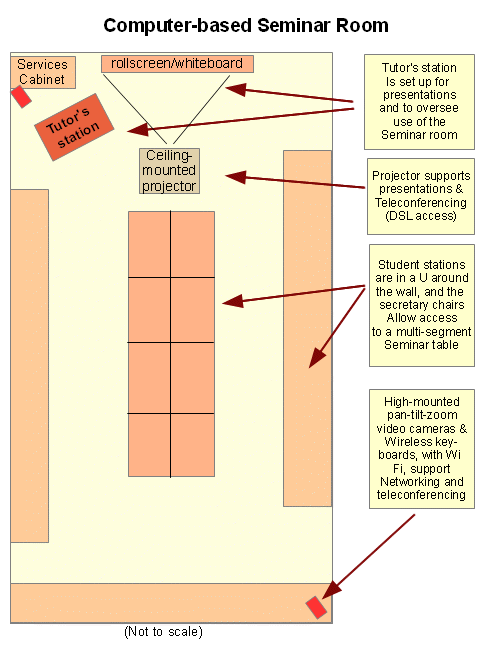
Such could be delivered based on micro-campus centres featuring multimedia learning resource centres that can readily be hosted by many church facilities across our region:
And to provide intellectual muscle, we need a good M.Ed programme also:

In short, we have a way to build required capacity.
Beyond, a more balanced view than last days fatalism would reckon with the themes of Spirit given revival AND demonically motivated riot that not only run through the Acts but can be seen in the wider pattern of teaching on the church's mandate.
As I noted above already:
Given the parable of sower, seed and soils, we can readily see how some repent deeply and utterly transformationally, some are temporarily moved, some are in a strange half-way house where the fruitfulness of the gospel is choked by the deceitfulness of riches and the cares of this life. Given power systems, agendas, ideologies and centres/pillars/ mountains of influence in the community, there is an overall impact which may change over time. The Acts shows how revival and riot often run in a race in a given community, sometimes leading to grave miscarriages of justice as opponents of the gospel (often for religious or business reasons) carry out vigilantism, mob action or outright lawfare that targets the witness of the gospel.In short, there will be growing, global struggle, leading to rising waves of both Spirit-led revival and devilish riot. And that means in turn that those who labour in strategic apologetics, in broader prophetic intellectual and cultural leadership, in governance and government, as well as in strategic change towards truly sustainable development must be properly educated, equipped, commissioned and sent, understood, appreciated, supported and sustained in the work of a modern-day Daniel or Nehemiah.
So, we most likely see at first a counter-culture strategy emerging, as a truly godly remnant under pressure or outright persecution models gospel transformation in a suspicious or outright hostile community. Over decades to generations, there may well be a rising tide as waves of renewal and revival surge into the community. That tide may reach a peak [= reformation] where the community begins to identify itself as Christian, joining Christendom. But of course that brings to bear the complex -- and too often poorly understood -- challenge of the compromises, sins, and blessings of Christendom. Where, too, we face what the letters to the seven churches in The Revelation and the centuries of history in the OT highlight: the repeated rise of heresies, misleaders and of apostasy leading to cycles of judgement and renewed repentance.
The attack against such coming from the criticisms just cited as "typical" cannot be right.
Not all are called to such leadership, but those who are should not be smeared through guilt by association with new ageism, or undermined through unjustified accusations of false teaching and/or being or following false prophets.
It is time for us to do better, a lot better. If not now, then when? If not here, then where? If not us, then who?
DV, more to follow. END


