Wednesday, November 20, 2013

Matt 24 watch, 229a: While reports suggest a done Munich II deal made in secret by Valerie Jarrett, the Saudis -- yes, the SAUDIS -- are unhappy with the Obama administration's ongoing Geneva diplomatic nuke game with Iran . . .

A week ago, I expressed serious concerns about the ongoing Geneva negotiations with Iran over its push towards nukes. In the course of those remarks, I cited a Times of Israel report that noted from Israeli TV news and views shows how:
 Israel’s Prime Minister Benjamin Netanyahu is “in a state of shocked disbelief” at the deal apparently taking shape in Geneva over Iran’s nuclear program . . . . The Netanyahu government is “in a crisis of faith” with the Obama administration over the possible deal, Israel’s Channel 1 News further reported, in part because it apparently differs in content from the terms that Kerry had previously described to Netanyahu. Other Israeli reports said Netanyahu felt he had been “misled” by the US over the terms of the deal. 

Netanyahu, who blasted the possible accord as the “deal of the century” for Iran, believes it would enable the Islamic Republic to become a “nuclear breakout state,” the TV reports said — since Iran would retain its nuclear enrichment capabilities, and would thus be capable of racing to a bomb at short notice at a time of its choosing. 

Israel, the TV reports said, also believes the US has been negotiating with Iran in a secret channel, without disclosing the content of those discussions to Israel . . . 
 A further TOI report, datelined Nov 17 - 18 (as at this point -- for cause  -- Obama administration denials have little credibility on either domestic or international events and issues . . . ), now allows us to flesh out those concerns, and make a very significant timeline cross-link to other developments:
‘Geneva talks a facade, US-Iran worked secretly on deal for past year’
White House denies report Obama team has been negotiating terms with Tehran, didn’t fully coordinate with Israel
November 17, 2013, 10:38 pm Updated: November 18, 2013, 2:07 am
 [ . . . ]

The Geneva negotiations between the so-called P5+1 powers and Iran are a mere “facade,” because the terms of a deal on Iran’s nuclear program have been negotiated in talks between a top adviser to President Barack Obama and a leading Iranian nuclear official that have continued in secret for more than a year, Israeli television reported Sunday. 

Despite ostensible full coordination between the US and Israel over strategies for thwarting Iran’s nuclear weapons drive, the administration did not keep Israel fully informed on those talks, Channel 10 news reported, but Jerusalem nonetheless has a pretty clear picture of what has been going on in the secret channel. 

White House spokesman Bernadette Meehan was quoted by Haaretz as saying that the report was “absolutely, 100 percent false.”

The report, which relied on unnamed senior Israeli officials, said the US team to the secret talks was led by Obama adviser Valerie Jarrett. Her primary interlocutor, the report said, was the head of the Atomic Energy Organization of Iran, Ali Akbar Salehi. The talks have been taking place in various Gulf states.

In the course of the talks, the report said, the Americans offered the Iranians a series of “confidence-building measures,” which underlined American readiness to conclude a deal and undercut sanctions pressure.
It was the deal discussed in these secret talks, the report said, that the Americans then brought to Geneva earlier this month, where it was largely adopted by the P5+1 nations — the US, Britain, France, Russia, China, plus Germany . . . . 

Sunday’s Channel 10 report was not the first to assert a secret US-Iran channel involving Obama aide Jarrett. In November of 2012, the daily Yedioth Ahronoth said Jarrett — a Chicago lawyer born in Shiraz, Iran, to American parents, and good friend of Obama’s — was “a key figure in secret contacts the White House is conducting with the Iranian regime.”

That report said “Jarrett served as the personal and direct emissary of the president to secret meetings with the Iranians, which are understood to have taken place in one of the Gulf principalities.”
 So, at this time, we have two separate Israeli reports on a pattern of negotiations using a personal emissary of Mr Obama who is Iranian.

Frankly, at this point, unless there is strong corroboration of the Obama administration talking points, I am for cause inclined to hold them as of negligible credibility. That is the price a Government pays for building up a track record of betrayal and deceiving of those who trust them and support them.

Worse, the timing -- across a year -- coincides far too neatly with the immense pressure brought to bear on Israel at about the same time to back down from striking the Iranian nuke programme. 

Which of course was also shortly before an American Presidential election and in the context of betrayal of diplomatic and security personnel fighting for their lives on the ground in Benghazi, multiplied by manipulating the public perception of these events. Mix in the recent expose of deceit since 2010 on implications of the Obamacare health insurance scheme, and the current US administration does not come up smelling like a freshly picked rose.

U/D 1, Nov 21:  Let us remind ourselves of the reach of Iran's existing and in-development ballistic missile capacity -- the Shahab 1, 2, 3, 4 & 5 -- since c 2008, asking ourselves just what Iran intends to put on such missiles with such a reach (pardon fuzzy text), why:


U/D 2, Nov 21: Paul Mirengoff of PowerLine blog, notes from French television media:
Iran’s “Supreme Leader” Ayatollah Khameni has assured his militiamen that Israel is “doomed to failure and annihilation.” In the same speech, which was broadcast live on State television, Khameni added that “Zionist leaders cannot be called humans.”

Have you seen this reported by our [US] mainstream media? I haven’t. It came to my attention via French television. [--> Something like this should have been headlined, on raw news value and timeliness,so lack of headlines is itself a significant warning . . . ]

Common sense suggests that a nuclear arms deal with a nation whose top leader holds such views is not worth reaching unless it ensures the dismantling of that nation’s nuclear arms capacity. Common sense further suggests that such a nation will not agree to dismantlement, and Iran has not agreed to it . . . .

 We the public of the world obviously need to know that it was not just Ahmadinejad (who was in any case largely a figurehead), but the Supreme Leader. Where, he has set out to dehumanise Israelis, a major warning sign already. A sign we must multiply by the continued threat of annihilation of Israel.

The rockets are in place and/or are under development, and it is patent that the warheads are under development. Nuke warheads.

And if -- as it seems some have argued [forgetting the grim lessons of Nazi Germany]  -- the supreme leader is only giving "red meat" to his public and military, what does that say about the underlying mindset, attitudes and stability of the regime and its institutions?  

Plainly, Mirengoff is right to conclude:

No one doubts that Khameni is ready to deal. He wants sanctions to be weakened and then terminated in exchange, basically, for not pressing ahead much with his nuclear program. The question is whether we should reach such a deal with a leader who talks about the annihilation of Israel and its subhuman leaders . . . . Under the kinds of deals being discussed, it appears Iran could [break out and create nuclear weapons] in a matter of months. 

That is why only dismantlement is acceptable.
 Then, too, we need to factor in the Saudi response, this time, as brought to our notice via Reuters, in a now more than month-old but highly relevant report:

Insight: Saudis brace for 'nightmare' of U.S.-Iran rapprochement

RIYADH Wed Oct 9, 2013 1:51pm EDT


When Saudi Arabia's veteran foreign minister, Prince Saud al-Faisal, made no annual address to the United Nations General Assembly last week for the first time ever, his unspoken message could hardly have been louder.

For most countries, refusing to give a scheduled speech would count as little more than a diplomatic slap on the wrist, but for staid Saudi Arabia, which prefers backroom politicking to the public arena, it was uncharacteristically forthright.

Engaged in what they see as a life-and-death struggle for the future of the Middle East with arch-rival Iran, Saudi rulers are furious that the international body has taken no action over Syria, where they and Tehran back opposing sides.

Unlike in years past, they are not only angry with permanent Security Council members China and Russia, however, but with the United States, which they believe has repeatedly let down its Arab friends with policies they see as both weak and naive.

Like Washington's other main Middle Eastern ally, Israel, the Saudis fear that President Barack Obama has in the process allowed mutual enemies to gain an upper hand . . .
 In short, the Saudis are very concerned that the Obama administration is about to cede the Middle East to a renewed Persian empire, armed with nukes and the ballistic and cruise missiles to deliver them as far as Europe already, and soon the whole world.

However, I don't buy the idea that any American administration c 2013 is being naive, as I noted a week ago:
By forcing a delay to now, blocking Israel from acting a year ago, the US may actually have already let Iran reach the nuke threshold, in which context, the agreement proposed would have sealed the deal that a nuke Iran is acceptable to this Administration. 
We now know those talks with Iran also amounted to effective abandonment of containing Iran's nuke ambitions, multiplied by deceiving what have to now be deemed former allies in the Middle East, not only Israel but Saudi Arabia and the cluster of states near enough to Iran to be under threat of a nuke umbrella -- immediately, those within 1,500 miles given the range of an intermediate range ballistic or cruise missile. (And if such are mounted on ships, that is a global threat. Indeed, IslamIST terrorism backed by a nuclear Iran would become an instant global nuclear threat.) 
That is what we now seem to be at the threshold of facing. 
I hate to say this, and know some will be angered by such a chain of reasoning -- especially as updated, but logic in light of evident facts and consequences that MUST be recognised in strategic decision making centres in Washington DC, Jerusalem, Tehran, London, Paris, Moscow, Beijing and elsewhere now pushes me:
I: this is patently too co-ordinated, too neat and definitive in potential outcomes -- and too well timed to exploit a predictable distraction over a controversial US domestic policy issue that has been bubbling up since 2010 -- to be mere coincidence and feckless bumbling. 
II: It looks deliberate. 
III: There is no way the senior officials in Washington could be unaware of the chain of highly likely geostrategic consequences outlined above.
_________________________________________________ 
Conclusion: 
IV: Obviously, those consequences are acceptable to them and reflect a fundamental alienation from Israel and willingness to live with the sort of Middle East that is emerging.
Though many Americans would not agree with such a re-alignment, it is obvious that they have lacked the capability to block any number of radical and questionable "change[s]" emanating from this administration.  
Further conclusion:
V: The United States is being fundamentally realigned in the post-Christian, secularist, statist European mould, and:
  •  it seems the balance of forces is now on the side of that re-alignment,  
  • from seeking to corrupt marriage (the most fundamental civilisation-stabilising social institution)  under false colours of equality and rights, 
  • to massive statist takeovers of major sectors of the US economy 
  • to alienating hitherto pivotal allies across the world (especially in major trouble-spots)  and 
  • allowing or even actively enabling the rise of fundamentally hostile powers to a place where 
  • they will predictably seriously hamper or even block any future US geo-strategic actions designed to be protective of the free world and pivotal trade choke points, starting with no 1 and 2 -- the Persian Gulf and the Suez Canal. 
  • Thus ushering in a new post-Christian era with radical Islam as the pivotal power bloc [probably envisioned as a third world champion and balance/ check to US imperialism . . . about as likely as Germany under Hitler was as a check to French and British Imperialism . . . ]
That very unwelcome summary is a recipe for global chaos and war on a scale hitherto unimaginable . . . .  the nuclear Armageddon clock just took a long step closer to midnight.
 We can multiply this by Mr Netanyahu's recent comment to the German newspaper, the Daily Bild, that Iran evidently has enough low enriched material to build five nuclear weapons:
“The Iranians already have five bombs’ worth of low-enriched uranium [--> which can plausibly be enriched to bomb-strength U-235 in as little as two weeks] ,” he told the German daily Bild. “If you press the sanctions now, you might actually get a better deal. If you have a bad diplomatic solution — what this appears to be — you actually may get the consequences you want to avoid. That is, you would have no choice but to exercise a military option in the future.”
As a final but one cited comment, we may note the assessment by Amos Yadlin, former IDF Intelligence Chief:
“Those who overestimate the threat of regional escalation damage the credibility of the military option and encourage a situation in which this becomes the only available option for preventing Iran from acquiring a nuclear weapon,” wrote Maj. Gen. (ret) Amos Yadlin, the director of the INSS think tank, and research assistant Avner Golov in a recent issue of Strategic Assessment (PDF) . . . . 

Yadlin and Golov described five possible Iranian responses to a strike, ranging from total military restraint to full-blown regional war, and asserted that the most likely scenarios were two gradations of a limited response. The first, “the classic reactive strategy,” would be a tit-for-tat strike in which “a significant number of missiles would be launched from Iran and Lebanon in the direction of Dimona or any other target in Israel perceived as ‘nuclear-associated,’” the two wrote.


A more significant reaction, but one Yadlin and Golov also considered to have “a high likelihood” of being chosen, would include one or two missile volleys at Israeli cities, a strike against Saudi and Western interests in the Gulf, and air and sea suicide missions.

A more robust and deadly response, in which Iran launched dozens of missiles a day against Israeli cities — as a declaration of outrage against the violation of its sovereignty or as a means of deterring Israel from any future action — “would lead to a significant Israeli response and could lead to escalation of the conflict… which could threaten the continued survival of the regime.” So long as a Western strike focused solely on the nuclear program and not wider regime assets, the two wrote, the regime would likely refrain from such a response.

So, we need to take very seriously (HT: TOI) Mr Netanyahu's just past security chief, Yaakov Amidror, when he said to the UK Financial Times that Israel is both capable and willing to act even unilaterally to set back Iran's nuke programme for a very long time.  Nor, should we dismiss the London Times report -- via TOI -- that Israel and Saudi Arabia may be working together on plans for such a strike against Iran. Especially, given this withering assessment in a paragraph by Israeli columnist David Horovitz:
Israel always knew the Obama Administration was all about “engagement” and that it would keep open the door to a diplomatic arrangement with Iran almost indefinitely. But there were those in Jerusalem who did not rule out an American resort to force, under certain circumstances, until the Syrian chemical weapons crisis over the summer. At that juncture, the horrified American public and Congressional reaction to the prospect of imminent conflict with Syria further hardened the Administration’s determination to do whatever it could to resolve the Iranian nuclear crisis without resorting to force. And, since then, Israel has broadly concluded that — while the US insists it is not bluffing, and while it has made preparations for military action — there is no credible American military option.
In short, things are very serious indeed, and absent a few miracles -- for which we need to pray -- are liable to rapidly deteriorate. END

Rom 1 reply 42 (& Ac 27 test, 10 ): The pivotal importance of self-evident moral truths and rights for just governance in a sound and thriving community (vs the chaos and absurdity implicit in subjectivism, radical relativism and hyper-skeptical evolutionary materialism)

Paul's ship of Ac 27, wrecked at Malta
because of the march of folly
We live at a time where the very foundations of morality, rights and justice are rapidly being eroded in our civilisation. A key driving force in that erosion is the rise of moral subjectivism, radical relativism empowered by hyper-skeptical evolutionary materialist secularism dressed up in the lab coat. 

Or, should that be: The Lab Coat.

So, in the spirit of sound democratic governance we can see the vital need for in light of the lesson of Ac 27, we need to decisively answer the siren-songs that invite us to a march of folly, much as Paul encountered at Fair Havens in Crete, and which ended in predictable shipwreck. But, as we know all too well, what is sound or prudent is ever so easily shouted down, distracted from or drowned out and dismissed then forgotten in the public arena and in the councils of decision-makers alike.

But, to be the good man in a storm and impending shipwreck, one must first be the lonely and derided voice of sound counsel in the face of the march of folly.

Now, in the Uncommon Descent blog where I contribute and comment, this problem has come up recently in several threads, and in answer to it, the issue of self evident, pivotal moral truths as eye-opening corrective cases has come up. 

Predictably, there has been a fierce back and forth.

Some of that is well worth reproducing here at KF, and I would like to share two contributions, first this from my comment here. I will make a few adaptations, taking advantage of the facilities of a full blog post:

_______________

>>KF, 40:  In glancing back at the above, it is clear to me that a pivotal question is to clarify self evidence for record, and to apply that to moral issues (including the point that not all cases of murder are self evidently wrong and why that is the case).

Now, a self-evident truth will meet several criteria, in order to be clearly, certainly and patently true and knowable as true on pain of absurdity:

1 –> It must actually be true, i.e. it accurately describes reality (as we credibly experience it as conscious, self aware, knowing, understanding creatures . . . BTW [--> as this was raised earlier in the thread of discussion by an objector, cf. my reply here on]  the parallel lines postulate is indeed true in the sort of space it describes, whether or no our actual world in the large is that sort of space . . . )
2 –> It must be seen to be true, once one understands what is being asserted in light of common experience of being such a creature.
3 –> It will also be such that it MUST be true, on pain of patent absurdity on attempted denial.
4 –> That is, to deny it, one has to immediately descend into clinging to the patently false [which includes but is not limited to the obviously self contradictory], chaotic, destructive, nonsensical, etc. (Think of denying 2 + 3 = 5 as a paradigm, or denying that error exists or denying that we are conscious.)
{It is worth the while to add a short note from 12 in the same thread:
KF, 12: . . .  it is on attending to and understanding a SET in light of experience of the world as a rational, aware, insightful mind, that one sees it true and necessarily true on pain of absurdity. I think in too many cases modern or ultra-modern absurdities pivot on a sort of induced secondary misunderstanding. Put another way: if you believe an absurdity to be true and reject or even stoutly resist correction, then there remains only the inversion that tries to label the true as false or incomprehensible. And yes, such is delusional, which looks uncomfortably like an ever spreading state of mind in our civilisation, which seems more and more bent on the march of folly. Notice above, how I have tried to awaken clean rational insight to see clearly that which should be intuitive, and to see clearly what happens on attempted denial.}

The point is, such extends to not only arithmetic or consciousness or human fallibility, but to morality also. To see how this applies to the world of morality, let us start with an example, as that helps us be clear and gives us a basis for looking at other cases by family resemblance. I will therefore now use the historically important and famous example of the US DOI, 1776:

The original US Declaration of Independence,
1776 (HT: History.com)
We hold these truths to be self-evident, [cf Rom 1:18 - 21, 2:14 - 15, 13:8 - 10], that all men are created equal, that they are endowed by their Creator with certain unalienable Rights, that among these are Life, Liberty and the pursuit of Happiness. –That to secure these rights, Governments are instituted among Men, deriving their just powers from the consent of the governed, –That whenever any Form of Government becomes destructive of these ends, it is the Right of the People to alter or to abolish it, and to institute new Government, laying its foundation on such principles and organizing its powers in such form, as to them shall seem most likely to effect their Safety and Happiness . . .
The basic fact that in our quarrels — and this is a famous one — we instinctively find ourselves demanding to be treated fairly in light of a binding expectation rooted in our value and equality as being human, speaks loud and clear. 

That is, we are patently, publicly, inescapably and knowingly under moral government as inherently social creatures. 

This holds from our being in the wombs of our mothers — who are rendered extremely vulnerable thereby and so need the dedicated protection of the family and community — and on through our helpless infancy in which we can only plead for help by our cries, on up into adulthood in which we too in turn become nurturing parents. We therefore plainly live in a world where moral government makes sense, there is a foundational IS that properly grounds OUGHT, for us as individuals across our lifespan, and for the families and communities without which we would struggle to survive much less thrive. For which IS, there is — across time and civilisations  —  only one truly serious candidate, the inherently good Creator God who has equally made us in his image and thus we rightly have well grounded, binding expectations that our lives, liberty, and fulfillment of purpose and potential should not be unduly infringed. We have inalienable rights.

Which by their inherent nature as binding expectations to be treated with appropriate respect for our value as human beings, implying that others must choose aright to so treat with us, is inescapably moral. Ought is real, and pivotal.

Now, to deny or act against such lands us in a morass of chaos and inconsistencies, undermining the framework of our value and thriving. 

A chaos that is immediately apparent on reflection for a normally functioning, experienced human being with a functional conscience unwarped by blinding ideologies or interests. (For instance, a major tactic of the abuser or oppressor is to dehumanise or demonise the intended target. People from Africa kidnapped into slavery were portrayed as criminals being transported, then were projected as inherently inferior and sub human — never mind what was going on in the slave huts at night. Similarly, Stalin turned industrious and prosperous peasants into a criminal class and manufactured the spectre of traitors everywhere. And Hitler and co turned Poles, Jews and Slavs into subhuman prey, the mice to Nordic Cats, who were deemed superior as they had been chosen through natural selection for strength and health in the hard conditions of the ice age.)

In short, widespread injustice is a moral issue and its violations of human value frustrate human thriving, individually and collectively. So, an obvious trend to social disintegration into chaos and the war of might makes or grants ‘right’ if a given behaviour becomes widespread should be taken as strong evidence that the behaviour patently ends in absurdity.

In that context, we can see why kidnapping, torturing, raping and murdering a child is a blatant case of that which is self-evidently wrong and ought not to be done. 

For it takes a paradigm case of an undeniable but vulnerable human being with vast potential, and twists that human being into a discardable toy to be used in ways that take twisted pleasure from inflicting pain and then robs the child of his or her life, tossing away the resulting broken body like trash. That child is a human being, undeniably, and as a child is by definition growing up into his or her potential. That child cannot consent to sexual activity, and is probably protesting and trying to cry out for help — which calls forth powerful protective instincts, but to no avail. Then the pervert finds some way to silence the cries and takes the victim to some secluded location for he knows — notice, KNOWS — that any decent person chancing on the scene will intervene with all desperate and even lethal force to rescue the child from the predatory criminal. 

Then, knowing himself to be secure from discovery, the selfish pervert takes sick and sickening thrills from helplessness hoping for rescue futilely, and delights to inflict pain, humiliation, suffering, then takes a final twisted pleasure in putting out the spark of life, maybe further abusing the body before discarding it as if it were rubbish.

Instinct alone, tells us that we understand just what is going on and cries, nay screams: wrong, absurdly wrong. Violation. Wanton despoiling and destruction of the vulnerable and precious.

And we cannot even conceive a society that descends into a state where that is deemed a ho-hum norm. For, we know that long before that happens, family protective instinct will come into play: families and clans will resort to ruthless blood feuds in defence of their young, leading to the collapse of community government. And we all know where a situation of clans and blood feuds ends, a barbaric chaos that is absurd by contrast with a well ordered well governed community.

So, we can see and know that such is wrong and must be wrong on pain of absurdity. In multiple ways.

So much so, that — as has happened over and over here at UD when this same paradigm case has come up again and again — the rhetorical tactics of those who would undermine the principles that ground that cannot come out directly and assert that one is and should be free to destroy a child like that. No, they have to pose on domineering skepticism, they have to refuse to acknowledge that conscience may be a built in moral sense as valid in its own sphere as eyes and ears; with the same proviso that we may be blinded or deafened or mistake one thing for another. They have to turn about the burden of proof, they have to confuse terms and concepts, they have to divert attention from the actual case on the table, and such like. 

Which brings up why not all cases of murder are self-evidently wrong. For, in some cases, sufficient confusion as to human status can be thrown up, or the chaotic consequences can be apparently confined or pushed to fringe groups that can be dehumanised or demonised, or the pretence can be made that the act was legitimate self-defence etc. Abortion for convenience, the abuse of slaves, mass delusions linked to deeply enculturated racism, etc. come to mind.

That is why we need clear, paradigm, self evident cases that starkly reveal the underlying principles. Which, we may then extend to those that are less clear, by way of reformation.

And so we come full circle: it is self-evidently wrong, immoral, perverse, wicked and demonically evil to kidnap, torture, rape and murder a child.

If your worldview cannot heartily concur or does not provide a frame that has in it an IS that grounds this clear OUGHT, that worldview is morally absurd, perverse, destructive and dangerous. (One may live above what that worldview would naturally lead to — as conscience is a built-in moral sense, but the view gradually warps and dulls conscience, heart and mind in ways that are analogous to things that blind and deafen.)

As a paradigm example of such destructiveness and absurdity, I cite a notorious case — by way of warning and call to reformation — from Dr Clinton Richard Dawkins, Sci Am, August 1995, citing in a way that draws attention to the core issue:

Nature is not cruel, only pitilessly indifferent. This lesson is one of the hardest for humans to learn. We cannot accept that things might be neither good nor evil, neither cruel nor kind, but simply callous: indifferent to all suffering, lacking all purpose . . . .
In a universe of electrons and selfish genes, blind physical forces and genetic replication, some people are going to get hurt, other people are going to get lucky, and you won’t find any rhyme or reason in it, nor any justice. The universe that we observe has precisely the properties we should expect if there is, at bottom, no design, no purpose, no evil and no good, nothing but pitiless indifference . . . . DNA neither cares nor knows. DNA just is. And we dance to its music. [[ “God’s Utility Function,” Sci. Am. Aug 1995, pp. 80 - 85.]
To see my point, simply contrast the earlier case from the US DOI of 1776.>>

________________ 

Second, I think this one, from commenter SB is also well worth pondering. For, he aptly replies to some typical objections:

________________

>>  SB, 39:
[PHV]: I think that society could exist, could have rules, and could enforce those rules. That would be a “well-ordered” society for the descriptive value of “well.” I would abhor that society, of course.
You think order could be preserved while the judge, who supports the torturing of babies, rules against parents who want to protect them? You don’t think that would degenerate into a war of all against all?
Are you clear on what it means to be a moral subjectivist? Seems wrong to me is the same thing as bad, under my subjective analysis. Whether there’s a more objective test is what you are trying, and failing, to prove.
No, seems wrong is not the same as is wrong. You are simply wrong about that. “Is” refers to being, which is objective; “seems” refers to the perception of being, which is subjective. I am not trying to prove anything because self-evident truths cannot be proven. The Law of Non-Contradiction is like that. It cannot be proven. You know it immediately, just as you know the Law of Non-Contradiction.
Whoops. “You’d agree with me if you weren’t a bad person” is not a logical argument. It assumes the existence of what you’re trying to prove, making it—again—circular.
Again, you misunderstand. The Natural moral law, like the Law of Non-Contradiction (or the law of causality) cannot be proven. It is the standard by which other things are proven.
Moreover, “men of good will” disagree over “natural moral law” questions all the time.
No, they will not. No, they do not.
Is abortion always wrong?
Yes.
Even if the life of the mother is at stake?
An abortion is the direct taking of a life for the purpose of ending that life. It is always evil. If, on the other hand, the purpose of the medical intervention is to save the life of the mother and the baby is accidentally killed in the process, then that is not abortion and can be morally justified.
Is no one who disagrees with you on that question “of good will”?
It depends on how they react to the truth. Men of good will always follow the light they are given. If they refuse to follow that light, then they are not of good will.
As a practical matter everyone in this conversation feels that it is wrong.
No. Some of us know that it is wrong.
The question we’re trying to answer is, is that because it’s such an extreme example that any functional human being would be socialized to agree with it as a subjective standard, or is there a definable objective standard behind it? I think you’ve abandoned the effort of proving the objective standard—now you’re just rephrasing “it exists” in elaborate ways.
I never hoped to prove that which cannot be proven. I did hope to show that there is such a thing as an objectively good society, which is based on the standard that there is such a thing as a good way for a community to live, which is based on the standard that there is such a thing as a good life for a person. You appear not to agree.
How do you prove it to someone who disagrees with you? (“I feel like you feel the same objective standard I do” is, ironically, a subjective argument, not proof.) How do you distinguish between an objective rule and a consensus subjective rule? Are objective rules mutable over time, or not?
Well, a consensus subjective rule will always tyrannize the minority. (We many agree to enslave you few). On the other hand, the natural moral holds everyone to account—the many, the powerful, and the few. Justice is not possible under any other circumstances.

SB: Or, perhaps you believe that there is no such thing as a good and healthy society or that there is no way of distinguishing it from a decadent or perverse society.
I think those are subjective definitions. Once again, you’re assuming otherwise, not proving otherwise. A transplant from 1905 might consider our society decadent and perverse because we allow the consumption of alcohol and interracial marriage, yet be considered a moral paragon by his own community back in the past. Was he always a monstrous bigot, or did the objective standards change?
Well, it’s easy for you to say that I am not proving anything, because all you have to do is dismiss what is said and claim that it was ineffectual. That doesn’t require much intellectual exertion. In any case, the Natural Moral Law covers all those situations that you mentioned. The consumption of alcohol is not inherently evil. It is the abuse of alcohol that is evil and it is on that basis that the civil law should be based. Again, there is nothing inherently wrong with interracial marriage. So, the only issue at stake is whether the society will honor the natural moral law. 

SB: From what I gather, you don’t think it matters how a nation’s people behave as long as each member, including the leaders, gets to create his own morality.
Do I also eat babies and have concentrated molecular acid for blood? I have no idea where you gathered this nonsense. It has nothing to do with me or my beliefs. I have moral preferences. The way other people behave is relevant to those preferences. For example, I prefer freedom to slavery. If my neighbors become slavers, I absolutely think that matters, even if I’m not their target. That’s because I can and do value people who aren’t me—even strangers.
You are totally missing the point. You feel slavery is wrong, but you cannot provide any moral justification for telling others that they shouldn’t enslave. They, like you, are going by their feelings. In like fashion, you cannot tell those who do eat babies that they should stop. 

They feel they should; you feel they should not. 

SB: If, as it turns out, a leader’s subjective morality prompts him to enslave everyone else, then I have to ask: 

Would that be acceptable with you? If not, what is your basis for saying that it would be morally unacceptable for you and for everyone else?
No. My basis would be that I believe slavery is wrong.
So what? The slave master believes the slavery is not wrong. Why should your belief take logical precedence over his belief?
I don’t need an objective standard to hold that belief.
Of course you don’t need an objective standard to hold a subjective belief. That is obvious.
Once I hold it, it is logical for me to take action to implement it. I must weigh that implementation against the moral cost of taking action—such as infringing on others’ sovereignty—but that doesn’t preclude taking action.
You have not yet addressed the issue about the slave master who feels, like you, that it is logical for him to take action against you based on his beliefs. How should this be settled?
In your example, my belief that everyone has a right to be free would vastly outweigh my belief that the leader has a limited right to be self-sovereign, and I would certainly take action to oppose him.
So it is with him. You have settled nothing. He will war against you and you will war against him. Indeed, everyone, based on his individual and self-serving morality, will war against everyone else. Eventually, a dictator will step in to restore order and everyone will be enslaved, Do you not understand that this is the inevitable result of your moral relativism?>>
_________________

This is where ever so many have already reached, and it is where our civilisation is plainly heading.

We need to wake up fast and turn back, lest we plunge over the precipice, as lemmings are said to do.

We desperately need a new Reformation. To which the answer must be the Mordecai moment, three-pointed question: why not now. why not here, why not us?  END

Monday, November 18, 2013

Sci-Tech watch, 9: Understanding atoms, ions, molecules, compounds, acids, bases, salts and chemical reactions

A simple, popular image of the atom, based on
Rutherford's nuclear model.
The electrons are
shown orbiting a nucleus (which is in reality
quite small, maybe a marble to a football
field, i.e. about 100,000:1). Already, there are
complexities, as the electrons (-) and protons (+) attract,
so the former are shown in orbit similar to a
sun and its planets, but an orbiting charge should
give off energy as light, spiralling into the nucleus.
This brings us to Bohr's concept of fixed stable orbits with
distinct energy levels. And, the nucleus' + charges
must mutually repel, so there is a strong, short-
ranged nuclear force of attraction that counters
this. Neutrons share in this force and help to
stabilise the nucleus. The atom is about
3 * 10^-10 m across, and the nucleus, about 
2 - 15 * 10^-15 m.  That is, the first is about
3/10,000,000,000 th of a metre. (Source: Wiki)
Understanding the atom and related concepts  is a challenge for some in our schools -- especially when it comes to introductory chemistry. (This seems a bit strange for me, but then in my younger days the atom was a favourite popular science topic and image, so it at least seemed a familiar idea; part of ordinary mental furniture. Nowadays, I suspect, it is not and atoms and the like are essentially invisible in an era where for many, seeing is believing.)

How can we begin to understand the atom, with a view to first level chemistry?

I guess a good place is back in the 5th - 6th centuries BC, where the idea of an ultimate particle seems to have first come up. 

The idea is, take up a rock, a brick or the like. Split it in two, then split a half and keep going. Can this be repeated indefinitely, or is there a final particle that cannot be further cut in parts? 

The Greek horror of an actual physical infinity (here, infinitely small . . . ) suggested an answer: no, it has to stop somewhere, with a very small particle, the un-cuttable.

And so, Democritus gave that particle a name: A + TOMOS = not + cuttable. 

Ironically, of course, once we discovered an inner structure to what we came to call atoms, and once we  discovered radioactivity, it was seen that  the ultimate particles of chemical elements like Oxygen, Hydrogen, Carbon, Iron, etc -- could indeed be "cut" by using powerful enough forces. 

But the nuclear energies involved are about 1 - 100 million times those we see in chemical reactions or in the emission of visible light. 

Leaving off such awesome forces, atoms may give up or gain electrons in orbit -- becoming charged ions -- but have a distinct identity. So, we are able to identify an element as a pure, simple substance with only one kind of atom in it, and we can define the atom as the smallest particle of an element that has its chemical properties. (There are now something like 116 - 118 identified elements, and the number grows as researchers find ways to create new ones using nuclear forces.)

In that context, Chemistry in simple terms is the study of interactions of atoms as they react together by combining, splitting apart,  etc. 

For instance (using standard letter symbols for types of atoms and dashes to represent chemical bonds between atoms) we can see:


 H-H + H-H + O-O --> H-O-H + H-O-H

. . . or, in a more standard way of writing:

 2 H2 + O2 --> 2 H2O
Similarly, we can show using a similar conventional "Chemical equation" how hydrochloric acid  (HCl) reacts with Sodium Hydroxide (NaOH) to form common salt (i.e. sodium chloride) and water:


H-Cl  +  Na-O-H --> Na-Cl + H-O-H

. . . or, again in more familiar form:


HCl + NaOH --> NaCl + H2O

The idea here is that, at simple level, electrons orbit the nucleus in rings that "like" to be full -- the "Sun and Planets" model:


The first -- innermost -- orbit, takes just two electrons, and after that the next two take eight. If an orbit is nearly full, the atom will have a strong attractive force and will easily grab one or a few more electrons to fill up the "shell"  (becoming a negative ion, an ANION [oopsie, earlier error of memory . . . ]).

If an atom on the other hand has just passed a full shell so it now has one or two electrons in its outermost -- "valence" -- shell these electrons will be partly shielded by the completed shells and will not be so strongly held. Such an atom easily gives up those electrons and becomes a positive ion -- a CATION. 

These ionisation-prone atoms tend to combine to form ionic compounds, such as common salt -- as we saw for how hydrochloric acid and sodium hydroxide combine to form sodium chloride and water.

In electrolysis, electrodes pass an electric  current through a solution with ions and the cathode (-) attracts cations. The anode (+) attracts anions, often triggering chemical processes such as breaking apart water . . . take a look, tremendous . . . into Hydrogen and Oxygen, etc. 

This simple illustration (source) outlines what is going on:


(A "battery" such as we use in cell phones etc, does the reverse, using a chemical reaction to generate an electro-motive force, that can drive a current through an external circuit. Rechargable batteries, of course, can have the reaction reversed by applying a current that undoes the reaction.  This can be done for maybe 500 cycles, but then eventually it breaks down the battery and it has to be replaced.)

What about atoms that are in the "middle" of the periodic table , like Carbon? 

On this simple view, they can be seen as prone to "share" electrons in pairs with other atoms, forming covalent bonds. 

Where Carbon in particular is like a connector-block atom, forming huge molecules based on chains and rings of carbon atoms. 

It tends to form four shared bonds, pointing at the corners of a triangle-based pyramid, a tetrahedron. Of course, on paper, this may be shown as a flat sun and planets model, or even more simply as a cross-shape with a C-atom in the middle and four bonded atoms on the arms of the cross, e.g. here with Methane (CH4) -- the main component of natural gas:


This is the basis of organic chemistry [a major branch of Chemistry], and it is the basis for the complex protein, enzyme, carbohydrate and fat molecules used in the living cell.

But what about ionic bonds?

These are "simply" electrostatic. That is positive and negative ions attract, so in solid table salt, the ions form a crystal:


Three-dimensional bar and ball model of a crystal of NaCl (HT:WebElements )

In solution, obviously, the Na and Cl are broken up from the crystal. It turns out that water molecules -- though covalent -- are slightly polarised, with the O being somewhat negative. So, water tends to attract the Na+ and Cl- ions, in effect forming a ball of water molecules around them. This breaks up the crystal and the little clusters of ions surrounded by water molecules move about in solution. 

A closer look at the reaction that forms NaCl from hydrochloric acid and sodium hydroxide:


H-Cl  +  Na-O-H --> Na-Cl + H-O-H

. . . is now in order.

HCl is of course an acid. 

In solution -- it can exist as a gas (and is one of the gases erupted by volcanoes) -- it breaks up to form Chloride ions and hydrogen ions, which are going to have the balls of water molecules around them, though it is usual to talk about the H+ going with a single water molecule to form the hydronium ion, H3O+.

Acids are substances that on solution in water, form such H3O+ hydronium ions by releasing protons to the water.

Bases, like NaOH -- and this can be bought as a solid, caustic soda (used in toilet cleaners, caution dangerous) --form ions too. Sodium and OH- ions, hydroxonium ions in this case.

So, when the reaction occurs in solution, all that is really happening is that we form water molecules and leave Na and Cl ions floating in their balls of water molecules. But, of we should now allow this to evaporate or if we should heat it up to drive off the water, the reverse to dissolving happens, and hey presto crystals of NaCl form as the ions attract one another electrically and spontaneously hook up in the crystal structure. 

(Many years ago, I did this experiment as a fourth former, and we weighed the resulting salt, which was much as predicted. I don't remember if we snuck a finger tip into the liquid and tasted the salt while the teacher was not watching. (A bit risky as one does not know what might be there as a contaminant. No eating or tasting in and around Chemistry labs is very wise practice. Sniffing, too, needs to be very carefully done -- waft a bit to the nose by holding the mouth of the test tube away from you and gently fanning with hands. And remember, some gases are lethal in very small doses so be very careful to follow safety advice.)

Of course, one consequence of this is that we see that the chemical equation is really an equation that is based on rearranging of atoms, with mass being conserved. The input mass on the left and the output mass on the right will be the same, as atoms are not vanishing into thin air, nor are they popping into existence, they are only being rearranged form one compound to another. Where compounds are molecules made up from bonded groups of diverse atoms, such as H-O-H to make water. (Pure elements also often form molecules, bu the atoms are all of the same kind. In the case of Carbon, there are three main kinds of molecules that are commonly discussed (and a lot of other possibilities): diamonds -- a 3-d tetrahedral structure which is very hard indeed, graphite -- sheets made up from hexagonal clusters of C-atoms that slide over each other, used in pencil leads and as a lubricant, and  sixty-atom balls often called "Buckyballs.")

That brings up: how much does an atom or a molecule weigh?

We very nearly get the masses by adding up the masses of protons and neutrons with the much lighter electrons almost negligible (as they weigh in at about 1/1800 of the mass of a proton or a neutron). It turns out thought hat this is a little too much, because there is a special nuclear E = m*c^2 level energy that is taken up from the mass of the protons and neutrons when a nucleus forms. This is known as mass defect or binding energy, and it varies across the periodic table:


This is where atomic energy comes form, by splitting -- fission -- heavy nuclei like Uranium, U, we get energy released, and by joining small ones to make bigger ones  -- fusion --we get energy released also. Iron is the peak of the curve and will absorb energy to be split up or fused. (It is believed that stars work by fusing H to form heavier and heavier nuclei, then when a big enough star reaches Iron, Fe, it blows up in a supernova which can be as bright as a whole galaxy of hundreds of billions of stars, for a short time. When that happens, the really heavy elements are formed, and the explosion scatters materials to make new stars and planets.)

The Carbon-12 isotope of Carbon has 6 protons and 6 neutrons, and was chosen as the standard of atomic mass, weighing in at twelve atomic mass units, AMU. One AMU or u -- sometimes called a Dalton or Da -- is therefore:

1.660538921(+/- 73)×10−27 kg

For practical work we usually just use 1.66 or 1.6605 times 10^-27 kg. 

(10^-27 is the fraction 1/1 00000 . . . 0 with 27 zeros under the bar. Tiny.)

But, how many atoms of C would we have if we had 12 g of C-12?

ANS: The Avogadro number, 6.02214×10²³

This gives us a standard number of molecules or atoms of a given kind or substance, known as the Mole. Hydrogen gas is diatomic weighing in at 2.2 AMU, so 2.2 g of Hydrogen has the same number of molecules. Water has a molecular mass of 18 AMU, pretty nearly. 18 g of water has the same number of molecules. And so forth.

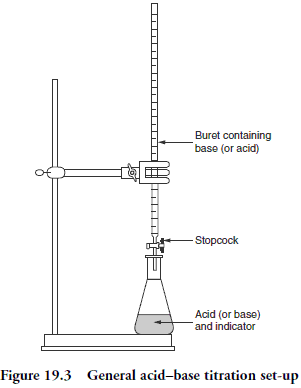
So, given that Chemical equations tell us the number of atoms, ions or molecules that interact to form a new set of substances, we can simply scale up from atoms and molecules etc to Moles by going from p AMU to p grams of the relevant substance etc. And of course, if we dissolve 1 mole of say Na Cl in water, and make up the volume to exactly one litre, we have a solution that is of concentration 1 mol per litre, often called unimolar. This is handy for chemical experiments, which often use solutions in water -- e.g. a titration in which 25 ml of 0.1 molar HCl is dripped out from a burette into a conical flask containing say 25 ml of 0.1 molar NaOH, with maybe an indicator that changes colour dramatically when the solution shifts from basic to acidic. One drop is enough at the end point to trigger that colour shift:


So, we have seen the basis in a nutshell for the chemical view of matter, and for seeing why Chemistry thinks in terms of atoms, ions, molecules, bonds, elements, compounds, reactions and of course acids, bases and salts.

One last thing, how physicists came to accept the general structure of the atom we see today.

In the 1890's, the electron was identified as a particle within the atom that appeared in ion beams and took part in various effects. That meant the atom had in it one or more electrons carrying a negative change and also had a balancing positive charge. That gave rise to the so-called Plum Pudding model with electrons scattered in a pudding of positive charge.

But then between 1909 and 1911, under Rutherford, experiments were done by Geiger and Marsden to shoot alpha particles -- known to be Helium atoms without electrons -- at thin sheets of Gold foil. It was expected that most would go straight through and some would suffer slight deflection. A Zinc Sulphide screen examined by a microscope was used to observe deflected particles, which would give tiny flashes that could be counted and the angle to the beam fired at the foil could be measured.

That did not happen.

Most did go through and some were slightly deflected, but a few bounced right back at very sharp angles. Rutherford said it was like firing a 15-inch shell from a Battleship's big gun at a sheet of tissue paper and having the shell bounce back and hit you:

 No more plum pudding model. 

There had to be a small, very dense hard core in the heart of the atom. And from the proportion of alpha particles bouncing back sharply, the size of the hard core of the atom could be worked out, about 10^-14 m for Gold.

That put us in the position of having to accept that electrons somehow orbited the nucleus and were locked in set orbits that they could only jump form one to the next by gaining or losing specific lumps of energy -- often, lumps of light called photons. 

This is of course the Bohr model of the atom, an early Quantum model.

 Beyond this, obviously there are many more details and complexities, but this should be enough for an early relatively simple picture of what is going on in Chemistry. And a lot of physics besides, too.

Let's see if we can discuss further and refine our thoughts. END