Imran Khan: There were prophets of Allah other [than Muhammad], but there is no mention of them in human history. There is negligible mention of them. Moses is mentioned, but there is no mention of Jesus in history. But the entire life of Muhammad, who was Allah's last prophet, is part of history.Immediately, this reflects an unwarranted but all too common anti-Christian bias against the eyewitness-lifetime New Testament documents; which are collectively historically and archaeologically well supported, with Luke-Acts as backbone. Secondly, on fair comment, it fails to recognise the difference in immediate public profile between a peaceful teacher and martyr and a ruler of an expanding state that imposed its will by the sword, which would obviously draw widespread attention. It is also tellingly ignorant of the cluster of early cross-references that provide corroboration to the outline of Jesus' life.
In case you need a reminder from "last time," on the atheistical front, notice this equally ill-advised assertion:

These two incidents of course reflect the two tidal waves pattern of cultural challenges to the Caribbean that we have so often highlighted:
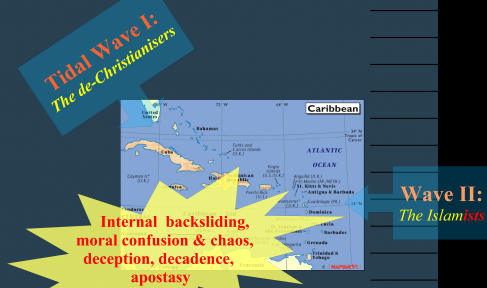
Of course, this points to the opportunity for us to rise up as the third tidal wave -- one that brings the Good News as the true "light rising in the West" (as UWI's motto declares):

Now, in first answer to Mr Khan and the atheists and fellow travellers of the FFRF, let us observe what Australian scholar Paul Barnett long since aptly and succinctly noted in Is the New Testament History?:
On the basis of . . . non-Christian sources [i.e. Tacitus (Annals, on the fire in Rome, AD 64; written ~ AD 115), Rabbi Eliezer (~ 90's AD; cited J. Klausner, Jesus of Nazareth (London: Collier-Macmillan, 1929), p. 34), Pliny (Letters to Trajan from Bithynia, ~ AD 112), Josephus (Antiquities, ~ 90's)] it is possible to draw the following conclusions:Such already suffices to refute Mr Khan's claims on want of relevant historical reference from Non-Christian sources.
[Is the New Testament History? (London, Hodder, 1987), pp. 30 - 31. Cf. McDowell & Wilson, He Walked Among Us (Nashville, TN: Thomas Nelson, 1993) for more details; free for download here.]
- Jesus Christ was executed (by crucifixion?) in Judaea during the period where Tiberius was Emperor (AD 14 - 37) and Pontius Pilate was Governor (AD 26 - 36). [Tacitus]
- The movement spread from Judaea to Rome. [Tacitus]
- Jesus claimed to be God and that he would depart and return. [Eliezer]
- His followers worshipped him as (a) god. [Pliny]
- He was called "the Christ." [Josephus]
- His followers were called "Christians." [Tacitus, Pliny]
- They were numerous in Bithynia and Rome [Tacitus, Pliny]
- It was a world-wide movement. [Eliezer]
- His brother was James. [Josephus]
It is important to focus the NT testimony. So, turning to Peter's theological will, 2 Peter, we may see also a telling rebuke to all such "myth" claims; in a record c. 65 AD that was literally sealed with this martyr's blood:
2 Pet 1:16 . . . we did not follow cleverly devised myths when we made known to you the power and coming of our Lord Jesus Christ, but we were eyewitnesses of his majesty. 17For when he received honor and glory from God the Father, and the voice was borne to him by the Majestic Glory, "This is my beloved Son, with whom I am well pleased," 18we ourselves heard this very voice borne from heaven, for we were with him on the holy mountain.
19And we have something more sure, the prophetic word, to which you will do well to pay attention as to a lamp shining in a dark place, until the day dawns and the morning star rises in your hearts . . . [ESV]Similarly, we note the official summary of the church's C1 first generation witness that Paul recorded 55 AD, recording the testimony of the 12 and the 500 which dates to 35 - 38 AD in Jerusalem (a key site, within a decade of the events):
1 Cor 15:1Now I would remind you,
brothers, of the gospel I preached to you, which you received in which
you stand, 2and by which you are being saved, if you hold fast to the
word I preached to you . . .
3For I delivered to you as of first
importance what I also received: that Christ died for our sins in
accordance with the Scriptures [--> cf. esp. the c. 700 BC Isa 52:23 - 53:12],
4that he was buried, that he was raised on the third day in accordance
with the Scriptures, 5and that he appeared to Cephas, then to the
twelve.
6Then he appeared to more than five
hundred brothers at one time, most of whom are still alive, though some
have fallen asleep. 7Then he appeared to James, then to all the
apostles.8Last of all, as to one untimely born,
he appeared also to me. 9For I am the least of the apostles, unworthy to
be called an apostle, because I persecuted the church of God . . .
11Whether then it was I or they, so we preach and so you believed. [ESV]
11Whether then it was I or they, so we preach and so you believed. [ESV]
We may also observe Luke's introductory remarks for his two-volume work (which by its 62 AD cut-off in Ac 28 shows how its base form dates to 57 - 62 AD, using Mark as a key underlying source [which therefore dates to the 40's - 50's AD and which records Peter's detailed testimony]:
Lk 1: 1 Inasmuch as many have undertaken to compile a narrative of the things that have been accomplished among us, 2 just as those who from the beginning were eyewitnesses and ministers of the word have delivered them to us, 3 it seemed good to me also, having followed all things closely for some time past, to write an orderly account for you, most excellent Theophilus, 4 that you may have certainty concerning the things you have been taught.
5 In the days of Herod, king of Judea, there was a priest named Zechariah,1 of the division of Abijah. And he had a wife from the daughters of Aaron, and her name was Elizabeth . . . .
Ac 1: 1 In the first book, O Theophilus, I have dealt with all that Jesus began to do and teach, 2 until the day when he was taken up, after he had given commands through the Holy Spirit to the apostles whom he had chosen. 3 He presented himself alive to them after his suffering by many proofs, appearing to them during forty days and speaking about the kingdom of God.
4 And while staying with them he ordered them not to depart from Jerusalem, but to wait for the promise of the Father, which, he said, “you heard from me; 5 for John baptized with water, but you will be baptized with2 the Holy Spirit not many days from now.”
6 So when they had come together, they asked him, “Lord, will you at this time restore the kingdom to Israel?”
7 He said to them, “It is not for you to know times or seasons that the Father has fixed by his own authority. 8 But you will receive power when the Holy Spirit has come upon you, and you will be my witnesses in Jerusalem and in all Judea and Samaria, and to the end of the earth.” [ESV]Turning to chain of custody (the other half of the famous Ancient Documents Rule), we can summarise:

Pulling back our focus, we may ponder the impact of the minimal facts method, as Habermas and others note how -- per an ever growing survey of the literature across the range of views (apparently now approaching or in excess of three thousand sources) -- the majority to an overwhelming majority of scholarship on the passion and resurrection of Jesus accept that we can identify a core of "minimal facts," up to twelve in number. In summary:
The minimal facts
method only uses sources which are multiply attested, and agreed to
by a majority of scholars (ranging from atheist to conservative).
This requires that they have one or more of the following criteria
which are relevant to textual criticism:
- Multiple sources - If two or more sources attest to the same fact, it is more likely authentic
- Enemy attestation - If the writers enemies corroborate a given fact, it is more likely authentic
- Principle of embarrassment - If the text embarrasses the writer, it is more likely authentic
- Eyewitness
testimony - First hand accounts are to be prefered
Early testimony - an early account is more likely accurate than a later one
Having first
established the well attested facts, the approach then argues that
the best explanation of these agreed to facts is the
resurrection of Jesus Christ . . . . [Source: "Minimal
facts" From
Apologetics Wiki. Full article: here. (Courtesy, Wayback Machine.)]
In substance:
1. Jesus died by crucifixion [--> which implies his historicity!].
2. He was buried.
3. His death caused the disciples to despair and lose hope.
4. The tomb was empty (the most contested).
5. The disciples had experiences which they believed were literal appearances of the risen Jesus (the most important proof).
6. The disciples were transformed from doubters to bold proclaimers.
7. The resurrection was the central message.
8. They preached the message of Jesus’ resurrection in Jerusalem.
9. The Church was born and grew.
10. Orthodox Jews who believed in Christ made Sunday their primary day of worship.
11. James was converted to the faith when he saw the resurrected Jesus (James was a family skeptic).
12. Paul was converted to the faith (Paul was an outsider skeptic).
The power of the method then lies in challenging alternative explanations to account for the relevant credible facts:[Cf. Habermas' paper here and a broader more popular discussion here. NT Wright's papers here and here give a rich and deep background analysis. Here is a video of a pastoral presentation of a subset of the facts. Habermas presents the case as videos here and here, in two parts. Here is a video of a debate he had with Antony Flew.]
We may briefly compare:
"Theory"
|
Match to four major credible facts regarding Jesus of Nazareth & his Passion
|
Overall score/20
|
|||
Died by crucifixion
(under Pontius Pilate) at
Jerusalem
c 30 AD
|
Was buried, tomb was found empty
|
Appeared to multiple disciples,
many of whom proclaimed
& suffered for their
faith
|
Appeared to key
objectors who then became church leaders: James & Paul
|
||
| Bodily Resurrection |
5
|
5
|
5
|
5
|
20
|
| Visions/ hallucinations |
5
|
2
|
2
|
1
|
10
|
| Swoon/recovery |
1
|
3
|
2
|
2
|
8
|
| Wrong tomb |
5
|
1
|
1
|
1
|
8
|
| Stolen body/fraud |
5
|
2
|
1
|
1
|
9
|
| Quran 4:155 -6: "They did not slay him, neither crucified him." | 1 | 1 | 1 | 1 | 4 |
| "Jesus never existed" | 1 | 1 | 1 | 1 | 4 |
| "Christianity as we know it was cooked up by Constantine and others at Nicea, who censored/ distorted the original record" | 1 | 1 | 1 | 1 | 4 |
| "What we have today is 'Paulianity,' not the original teachings of Jesus and his disciples" | 2 | 1 | 1 | 2 | 6 |
| Christianity -- including the resurrection -- is a gradually emerging legend based on a real figure |
5
|
1
|
1
|
1
|
8
|
| Complete legend/pagan copycat (Greek, Persian, Egyptian, etc) |
1
|
1
|
1
|
1
|
4
|
(I have given my scores above, based on reasoning that should be fairly obvious. As an exercise you may want to come up with your own scores on a 5 - 1 scale: 5 = v. good/ 4 = good/ 3 = fair/ 2 = poor/ 1 = v. poor, with explanations. Try out blends of the common skeptical theories to see how they would fare.)
Laying a priori anti-supernaturalism aside as a patent case of worldview level question-begging closed mindedness, the above table shows that there are two serious candidates today, the resurrection as historically understood, or some version of a collective vision/hallucination that led to a sincere (but plainly mistaken) movement.
The latter of course runs into the problem that such collective visions are not psychologically plausible as the cultural expectations of a resurrection would have been of a general one in the context of the obvious military triumph of Israel. Nor, does it explain the apparently missing body. Moreover, we know separately, that the culturally accepted alternative would have been individual prophetic visions of the exalted that on being shared would comfort the grieving that the departed rested with God. So, an ahead of time individual breakthrough resurrection -- even, one that may be accompanied by some straws in the wind of what is to come in fulness at the end -- is not part of the mental furniture of expectations in C1 Judaism. Where, hallucinations and culturally induced visions are going to be rooted in such pre-existing mental "furniture."
Where, also -- tellingly -- the women who bought spices and went to the tomb that morning plainly expected to find it occupied by a dead prophet, one unjustly judicially murdered as so many others had been. (And if you doubt the account that reports how these women became the first to discover the tomb and to see the risen Messiah, consider how dismissive C1 Jews were to the testimony of "hysterical" -- that very word in English is rooted in the Greek for womb, hustera (reflecting a very old prejudice . . . ) -- women. Such an embarrassing point would only be admitted if the reporter was seeking to tell the full truth as best as he could, regardless of how poorly it would come across to his audience; a C1 audience, not a C21 one.)
The Easter event cuts across all reasonable cultural expectations, and obviously forced a much closer -- transforming -- look at messianic prophetic passages such as Isa 52 - 53 which plainly led to an aha moment.
Moreover, the visions suggestion also runs into the problem of the empty tomb; hence the skeptical resistance to that otherwise quite reasonable fact.
(Remember, the NT record is that the women disciples who went to the tomb that first Easter Sunday morning to complete the burial rituals that had been hastily begun just before the Sabbath, on finding the grave open and the body missing at first thought the authorities had taken the body. These primary documents subsequently record the Sanhedrin's official talking point as that the disciples stole the body while the guards slept. Oops. The point of agreement is obvious: the body was missing, and neither group seemed to be responsible for it. [Cf below for more.])
You may think that this sort of balance of evidence should be well known and that educated, responsible and reasonable people would at minimum be willing to accept it as well-grounded that Jesus of Nazareth was a significant Galilean Jew and teacher who had clashes with the Jerusalem authorities which cost him his life. Whereupon, his followers then proclaimed to one and all across the eastern littoral of the Mediterranean and beyond over the next several decades, that Jesus was the prophesied Jewish Messiah, and that though shamefully (though unjustly) crucified -- blatantly true by the criterion of admitting an utterly embarrassing claim -- he was risen from death as Lord and eschatological Judge; until Nero would find it convenient to divert suspicion be falsely accusing Christians of setting fire to Rome in 64 AD.
Even Wikipedia (no friend of the Christian faith) concedes:
Jesus[e] (c. 4 BC – c. AD 30 / 33), also referred to as Jesus of Nazareth and Jesus Christ,[f] was a first-century Jewish preacher and religious leader.[12] He is the central figure of Christianity. Most Christians believe he is the incarnation of God the Son and the awaited Messiah (Christ) prophesied in the Old Testament.[13][14]
Virtually all modern scholars of antiquity agree that Jesus existed historically,[g] although the quest for the historical Jesus has produced little agreement on the historical reliability of the Gospels and on how closely the Jesus portrayed in the Bible reflects the historical Jesus.[21][h][i] Jesus was a Galilean Jew[12] who was baptized by John the Baptist and subsequently began his own ministry, preaching his message orally[24] and often being referred to as "rabbi".[25] Jesus debated with fellow Jews on how to best follow God, engaged in healings, taught in parables and gathered followers.[26][27] He was arrested and tried by the Jewish authorities,[28] turned over to the Roman government, and was subsequently crucified on the order of Pontius Pilate, the Roman prefect.[26] After his death, his followers believed he rose from the dead, and the community they formed eventually became the early Church.[29]
The birth of Jesus is celebrated annually on December 25 (or various dates in January by some eastern churches) as a holiday known as Christmas. His crucifixion is honored on Good Friday, and his resurrection is celebrated on Easter. The widely used calendar era "AD", from the Latin anno Domini ("in the year of the Lord"), and the alternative "CE", are based on the approximate birth date of Jesus.[30][j]
Christian doctrines include the beliefs that Jesus was conceived by the Holy Spirit, was born of a virgin named Mary, performed miracles, founded the Church, died by crucifixion as a sacrifice to achieve atonement, rose from the dead, and ascended into Heaven, from where he will return.[32] Most Christians believe Jesus enables people to be reconciled to God. The Nicene Creed asserts that Jesus will judge the living and the dead[33]before or after their bodily resurrection,[34][35][36] an event tied to the Second Coming of Jesus in Christian eschatology.[37] The great majority of Christians worship Jesus as the incarnation of God the Son, the second of three persons of the Trinity. A minority of Christian denominations reject Trinitarianism, wholly or partly, as non-scriptural.
But, sadly, as Mr Khan and FFRF all too tellingly illustrate, that is not the case.
It is high time that there was a serious re-assessment of the sort of confident manner dismissive assertions that we keep on seeing. END
PS: It would be remiss of me to leave out a sadly telling context for Mr Khan's remarks. For, as MEMRI goes on to note, he continued:
. . . Every few years, in some Western country, our dear Prophet is blasphemed against and dishonored. What is the consequence of this? Muslims become angry. We take to the streets in protest, [protestors] break things in our country. But what does it achieve? It enables the enemies of Muslims to tell people in the West: "See, Islam is a big religion that spreads violence." They get an opportunity to spread propaganda against Islam.I am sorry, but this push to secure Islam from fair comment criticism is simply not good enough.
Especially, coming from the lips of the Prime Minister of a country where a Christian woman. Asia Bibi was falsely accused of blasphemy, was pressured to convert to Islam under immediate threat to her life -- what else does a leather noose around her neck imply? -- and then languished for eight years under unhealthy conditions on death row. Where too, her province's governor and the Minister for minority affairs were murdered for trying to bring justice to a patently innocent woman.
And, to cap it off, THIS is what we see now that she is freed (and is subjected to a must not leave Pakistan order, also having just been denied asylum by UK PM May):

For shame, Mr Khan. For shame!

